

Categories
UAE Corporate Income Tax UAE Tax

Impact of UAE Corporate Tax on Law Firms and Professional Services Firms

Impact of UAE Corporate Tax on Law Firms and Professional Services Firms

1. Application of CIT to revenue of law firms and professional services firms

Applying the new UAE Corporate Income Tax (CIT) to law and professional services firms can be complex. This is, mainly, because the underlying structures of legal and professional firms may also be complex. In this section, we will first discuss firms structured as a regular legal person, such as a Limited Liability Company (LLC). We will distinguish between UAE mainland LLCs and Free Zone (FZ) LLCs. Subsequently, we will discuss entities potentially treated as transparent under UAE CIT, together with UAE branches of foreign (non-UAE) companies.

a. Legal Structures

i. Firm structured as a regular mainland UAE LLC

This type of corporate structure will frequently be adopted by several UAE law firms. UAE law firms have rights of hearing, therefore, they are necessarily owned by UAE (or GCC) nationals. Generally, they have no legal reason to be established in a UAE FZ and can, therefore, mostly be found in UAE “mainland” (i.e., non-FZ).

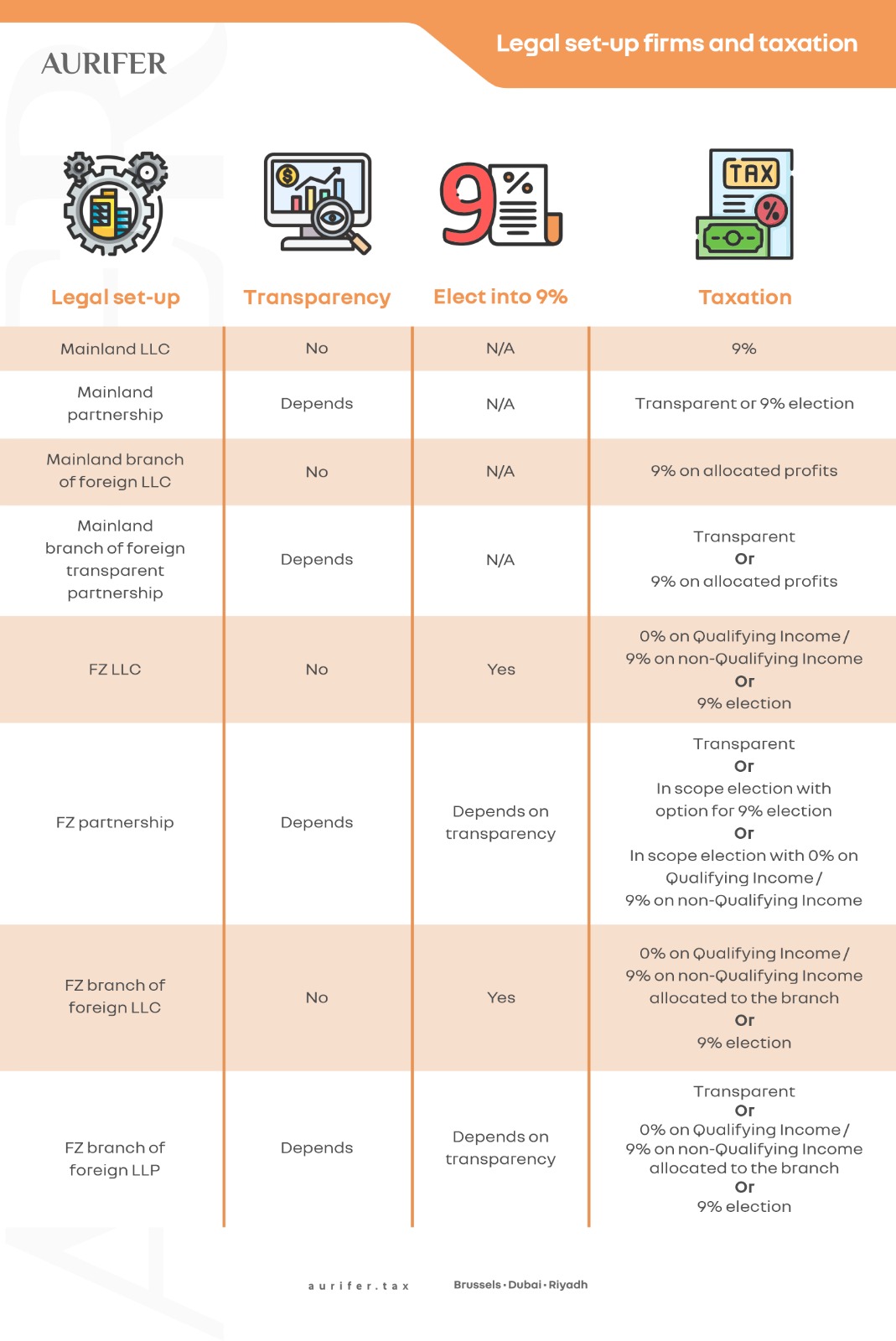
If so, UAE LLCs will be subject to 9% CIT on their worldwide profits, adjusted for tax purposes according to the relevant CIT legislation. This will be the default position for any law firms which are organized through a Limited Liability Corporation (“LLC”) in the UAE mainland.

ii. Firm structured as a mainland UAE partnership

An alternative legal structure may be that of a partnership. To this end, the UAE CIT law distinguishes incorporated and unincorporated partnerships.

The FAQs published by the UAE Ministry of Finance (MoF) provide examples of incorporated partnerships. According to the MoF’s FAQs, incorporated partnerships include Limited Liability Partnerships (LLPs), partnerships limited by shares, and other types of partnerships where none of the partners has unlimited liability for the partnership’s obligations or other partners’ actions[1].

This reference suggests that, where there is unlimited liability for corporate law purposes, the entity must be treated as transparent for CIT purposes[2]. This UAE approach is in line with that followed by other jurisdictions. Seemingly, incorporated partnerships where no partners have unlimited liability are subject to UAE CIT at the standard rate.

Unincorporated partnerships are described under the UAE CIT law as “a relationship established by contract between two Persons or more, such as a partnership or trust or any other similar association of Persons[3].

Unincorporated partnerships are not considered taxable persons in their own right. Instead, they are considered “transparent”. It follows from this that partners rather than unincorporated partnerships are liable to tax, so that those transparent vehicles generally cannot claim any benefits under double tax treaties (DTTs), given that they do not meet the liable-to-tax criterion under Articles 1(2) and 4 of the OECD Model Tax Convention (MTC)[4].

The UAE Commercial Companies (CC) law, which is applicable in the UAE mainland and in any Free Zone not regulating corporate law itself, refers to two types of partnerships, i.e., a Joint Liability Company (JLC) and a Limited Partnership Company (LPC)[5].

Under the UAE CC law, a JLC is a company consisting of two or more physical partners who are severally and jointly liable in all their personal assets for the entity’s obligations[6]. As such, JLC would likely be treated as a transparent entity for corporate law purposes. Joint partners of a JLC are considered traders, and they are deemed to be conducting commercial activities directly.

Under the UAE CC law, an LPC is defined as “(…) a Company which consists of one or more joint partners, having the capacity of traders, who shall be liable, severally and jointly, for the partnership’s obligations, and one or more silent partners who shall not be liable for the partnership’s obligations, except to the extent of their contribution to the partnership’s capital. Silent partners shall not have the capacity of trader.[7]

Given the criterion of “unlimited liability”, which the UAE seems to apply to both types of partnerships, JLC and LPC are likely to be treated as transparent for UAE CIT purposes, despite both being endowed with legal personality. This means that the individual partners will be considered as directly conducting the business, therefore being taxable persons of their own right liable to UAE CIT[8].

If transparency is not a preferred option, the legal entity treated as a partnership can file an application (i.e., an election) to be considered non-transparent (i.e., “opaque”)[9]. Where the application is successful, the status is effective from the start of the tax period in which the application is submitted or since the beginning of a subsequent tax period[10].

The election by an unincorporated partnership for non-transparency treatment under UAE CIT law is irrevocable, unless exceptional circumstances occur and subject to approval by the Federal Tax Authority (FTA)[11]. The unincorporated partnership, presumably only when transparent (since, otherwise, if opaque, the partners are disregarded for UAE CIT purposes), is required to notify the FTA within 20 business days from any partner joining or leaving its organization[12].

The underlying rationale behind an application for an incorporated partnership to be treated as an opaque structure and, therefore, as a full-fledged taxable person under UAE CIT could be:

  •  Relieving the partners from the tax compliance burden and achieving simplicity
  • Enabling the partnership itself to access any of the 137 DTTs concluded by the UAE

iii. Mainland UAE branch of a foreign LLC

Sometimes, foreign firms are organized by way of a branch in the UAE mainland. The carrying out of professional activities through a branch in the UAE does not just have regulatory advantages in terms of the setup of the branch, but, when taxed, may also have the advantage that the branch (i.e., permanent establishment) income may be exempt or excluded from the scope of corporate tax in the country of the head office’s residence (in particular, in case of countries using the exemption method to avoid international double taxation).

There are no specific rules applicable to UAE mainland branches of a foreign LLC. Their profits are, therefore, taxable at the standard UAE CIT rate of 9%.

Complications with UAE-established branches, however, may arise with the allocation of profits between head office and branches, which requires a careful transfer pricing analysis of the functions, assets, and risks, following the OECD’s recommended Separate Entity Approach[13].

The discussions around profit allocations to branches could lead to mismatches between the UAE and the other country concerned, potentially leading to international double or non-taxation of the same profits. It is, therefore, critical for legal and professional firms operating cross-border to seek confirmation with the tax authority on the taxation of their branches, as well as about the method to avoid double taxation in the country of residence (i.e., the country of the head office or first establishment).

iv. Mainland UAE branch of a foreign partnership

It is common that law (mostly) and professional services firms (less so) outside the UAE and GCC region are organized by way of a partnership or LLP. This is very common in some countries like the United Kingdom and the United States.

The partnership structure offers a number of benefits in terms of the flexibility of making partners entitled to profits, but also regulatory, administrative and legal ease of having partners enter and exit, as well as other elements such as profit share entitlement for partners. A partnership is usually treated as transparent for corporate tax purposes in the country of residence or first establishment. It follows that only partners are subject to tax, usually by levying a Personal Income Tax (PIT) on their profit share entitlement.

If available, these partnerships may prefer setting up branches abroad, in countries which consider the branches and their partnerships as tax-transparent. Tax transparency in a foreign country gives the partnership more leeway on concluding cross-border ventures, sweeping up all income and expenses into one pool, determining a bigger profit pool to then subsequently distribute profits to the partners based on their profits share entitlement.

The circumstance that a partnership operates abroad in a jurisdiction where the partnership is not treated as tax-transparent may potentially create what is called, in technical terms, a “source-residence conflict”[14]. Taxation in the country of source cannot be considered in the country of residence if the foreign partnership would not be liable to tax itself in its residence country in the first place.

Whether the country of residence would generally provide an exemption or a credit is irrelevant: in this instance, the taxes paid in the country of source can be regarded only as a business cost for the partnership. Some countries solve this international tax issue through a legal fiction, which consists of allowing the partners to claim the tax credit which would have accrued to the partnership, had it not been transparent.

For this reason, it is often beneficial to set up a full-fledged subsidiary in those countries where the local branch would not be considered tax-transparent and may have an alternative structure catering for the countries where partnerships are not tax-transparent.

The UAE has provided flexibility in the application of its CIT to UAE branches of foreign unincorporated partnerships. The treatment of foreign partnerships under UAE CIT aims to mirror the tax treatment in the country of residence of the unincorporated partnership. If the partnership in the country of residence is tax-transparent, then the UAE would allow the same tax-transparent treatment for the UAE branch of the foreign partnership.[15] This is also the most common approach followed by other jurisdictions[16].

If the foreign partnership is treated as tax opaque in the jurisdiction of first establishment, then the UAE will not consider the UAE branch as transparent and levy UAE CIT upon it accordingly. The UAE CIT treatment will then be the same as the one applicable to a foreign LLC which has a branch in the UAE.

The tax transparency of UAE branches comes with some conditions attached:

  • The foreign partnership is not subject to tax under the laws of the foreign jurisdiction, i.e., if it is subject to tax, it is not transparent[17].
  • Each partner is individually subject to tax with regard to their distributive shares of any income in the foreign partnership[18].
  • The foreign partnership submits an annual declaration to the FTA confirming it meets the above conditions[19].
  • Adequate arrangements exist for cooperation between the UAE and the jurisdiction under whose applicable laws the foreign partnership was established for the purpose of exchanging tax information on the partners in the foreign partnership[20].

We discuss each of these conditions further below.

   – Foreign partnerships not subject to tax

The complication around the application of the conditions laid down above is not so much on the requirement relating to the tax transparency of the foreign partnership. This is a condition which should be met, for example, in the case of a UK and US LLP. For partnerships established in other locations, an analysis will need to be made of the actual tax treatment of a partnership there.

   – Each partner is individually subject to tax

The second condition, in comparison with the former one, is less straightforward. Tax transparency assumes taxation is triggered at another level, i.e., at the partners’ level. In the case of a UK LLP, partners in the LLP pay PIT to the extent they receive the income as self-employed partners.

It should be noted that natural persons, when conducting a business, are also in the scope of UAE CIT[21], and, for UAE CIT purposes, “Business” is defined in the same way as it is in the VAT law[22].

As regards resident natural persons, earning wages cannot be considered as conducting a business, regardless of the wages earned[23]. A wage is defined as “The wage that is given to the employee in consideration of their services under the employment contract, whether in cash or in kind, payable annually, monthly, weekly, daily, hourly, or by piece-meal, and includes all allowances, and bonuses in addition to any other benefits provided for, in the employment contract or in accordance with the applicable legislation in the State” (emphasis added).

In the UAE, partners working in a local branch of a foreign LLP would generally have an employment contract. Without an employment contract, historically, foreign partners could not obtain residency in the UAE, given that they require a visa. Their employment contract dictates their remuneration, which generally consists of salaried income plus a (more rather than less) substantial bonus at the discretion of the law or professional services firm.

This implies that the requirement to be subject to tax for the partners in order to obtain transparency may conflict with their (non-tax) employment status. Therefore, the actual employment relations between the partners and the firm need to be thoroughly analyzed.

If the UAE resident partners are not to be treated as independent or self-employed, and therefore conducting a business for UAE CIT purposes, the UAE mainland branch would be considered taxable, thus creating a “source-residence conflict”, potentially leading to a higher tax burden for the partnership[24].

When it comes to UAE-resident partners who earn salaried income and are entitled to a profits share, the subject-to-tax condition may not be met. A remedy against it could be to provide equity partners with an employment contract with a nominal salary (e.g., “nummo uno” or AED 1), stating that this salary constitutes an advance on their profits share, and reclaim the nominal salary when their profits share is paid out.

When it comes to foreign (non-UAE resident) partners in the partnership, the partner is considered subject to tax if they would be subject to tax on their distributive share of any income from the partnership in his (i.e., that partner’s) country of residence[25].

   – Submission of annual declaration

The form and manner for this compliance requirement are yet to be defined by the FTA.

   – Tax information exchange agreement

It is unclear what the MoF is actually referring to with this condition. There is a wide variety of international agreements which countries enter into for the purposes of exchanging tax information.

If, with this condition, the MoF is referring to the equivalent of Article 26 of the OECD MTC, then the fact that the UAE does not have a DTT with all countries (the United States being a notable absentee in this regard) may prevent the application of tax transparency treatment of a foreign partnership.

However, other tax agreements may also regulate the exchange of financial information, which may eventually be used for UAE CIT purposes. This is the case of FATCA, which requires banks and other financial institutions in the UAE to exchange information on account holders with the United States[26].

v. Firm structured as a UAE FZ LLC or non-transparent entity

The first question which needs to be asked is whether the FZ-established firm is transparent for tax purposes. The Company Regulations for the specific FZ will need to be analyzed to understand whether any of the partners have unlimited liability. In those FZs, different regimes may apply. For example, the DIFC has a separate limited partnership regime[27], and so does the ADGM[28]. These regimes need to be analyzed on a case-by-case basis.

If none have unlimited liability, then the firm will be considered equivalent to an FZ LLC. Subsequently, the firm will need to analyze whether it earns qualifying income subject to 0%.

vi. Firm structured as a UAE FZ partnership

The first question which needs to be asked is whether the firm is transparent for tax purposes. The Company Regulations for the specific FZ will need to be analyzed to understand whether any of the partners have unlimited liability. In those FZs, different regimes may apply. For example, the DIFC has a separate limited partnership regime[29] , and so does the ADGM[30]. These regimes need to be analyzed on a case-by-case basis.

If the partners have unlimited liability, then the firm will be considered tax-transparent. The levying of UAE CIT then moves to the partners’ level. Presumably, the partners will not be able to claim the status as a QFZP, since this is reserved for legal entities only, and, therefore, will be subject to tax at the standard UAE CIT rate of 9%.

vii. Firm structured as a UAE FZ branch of a foreign firm

The first question which again needs to be asked is whether the firm is transparent for tax purposes. The same criteria apply as for UAE mainland branches of a foreign firm.

If the branch is not transparent, the same complications may arise as to the allocation of profits to the branch. Given that it is established in an FZ, when not transparent, it will need to ask itself as well whether its income constitutes qualifying income.

viii. Summary Table
b. Other Considerations

i. Tax Grouping

UAE companies are entitled to form a “fiscal unity” or Tax Group for UAE CIT purposes upon application before the FTA. The most important condition for a Tax Group to comply with is the (in)direct shareholding requirement of 95%. However, FZ entities whose qualifying income are subject to 0% cannot enter into a Tax Group. In addition, the parent (which can be intermediate) needs to be a UAE company. Under this arrangement, only one tax return needs to be filed[31]. These conditions also apply to partnerships or branches of foreign partnerships established in any of the UAE FZs.

The availability of Grouping would require that there are multiple legal entities in the UAE which are taxable persons under the same regime (i.e. the default regime where they are a taxable person)[32].

There are notable differences with VAT grouping, the most important of them likely being that the common shareholding percentage for VAT groups is 50% or more (whereas for tax groups it is 95% or more[33]), and for VAT groups Free Zone entities can be included, whereas Qualifying Free Zone Persons are excluded from entering a tax group[34].

Below is a comparative table comparing tax groups with VAT groups.

ComparisonCITVAT
ConsequenceConsolidation of profits and losses

Disregarding transactions between members

VAT group considered as one taxable person for supplies and purchases and for right to recover input VAT

Common ownership95% share capital, voting rights and entitlement to profits

50% voting/market value interest/control or side agreement

Common Economic, financial and regulatory practices

Inclusion FZ/Exempt taxable personsNoYes
Transfer lossesYesN/A
Intra-group transfersAt no gain/no loss with 2 year claw backOut of scope
Administration and paymentParentResponsible member
Joint liabilityYes – can be ring fenced on approvalYes
ApplicationBy parent and subsidiariesBy Responsible person

2. Expenses of a law or professional services firm

a. Expenses of an LLC or a non-transparent partnership

There are no specific provisions applicable to the expenses incurred by a law or professional services firm. Therefore, expenses borne by both types of firms are subject to the general UAE CIT rules. However, certain matters are specific to UAE law firms and professional services firms, which may be relevant to consider. Those are:

   – Deduction for UAE CIT purposes of paid remuneration

Employee’s remuneration, whether it is a base salary or other types of income allowances, constitutes a deductible expense for UAE CIT purposes. This holds true, irrespective of the nationality of the employee (i.e., UAE, GCC, non-UAE, and non-GCC). It might be assumed that pension and social security contributions, or GOSI contributions, for employees holding GCC nationality would also be deductible.

   – End of Service Gratuity and Pension Contributions for Non-GCC nationals

Employees who do not hold GCC nationality and who are not employed by a DIFC company are subject to the EOS regime, where employers need to provision an amount which is a multiple of their base salaries.

Currently, the UAE legislation does not provide for any treatment of such EOS provisions or other provisions for that matter. In our view, however, provisions created for uncertain future payments, write-off of assets, etc. will most likely not be allowed a deduction under UAE CIT. However, provisions that are created for expenses that are actually crystallized/incurred may be allowed.

For contributions into Private Pension funds made by an employer on behalf of the employees, the total value of contributions is deductible[35]. However, the value of each Pension Plan Member cannot exceed 15% of the total Pension Plan Member’s remuneration, which gives entitlement to a deduction under UAE CIT[36]. We understand this provision to state that one single member cannot benefit from more than 15% of the benefits in the plan in order for the payments into the plan to be deductible[37].

We would normally expect DEWS, the DIFC Employee Workplace Savings Plan to qualify. However, if there are fewer than seven employees with equal contributions, the 15% condition will not be met , and therefore the amount of deductible contribution will be capped at 15%.

For employees of a Qualified Free Zone Person (QFZP), however, the tax deduction entitlement and limitation above may have no tax impact if the QFZP only has qualifying income, being that income taxed at a 0% rate. A tax impact would materialize if a QFZP also earns non-qualifying income.

   – Bonuses

Bonuses are an important component of remuneration packages for fee earners and partners. Bonuses constitute the variable part of monthly or annual compensation, which depends on the monthly or annual financial performance of the law or professional services firm concerned. For fee earners and non-equity partners, those bonuses are usually granted as part of their remuneration package as employees. Bonuses are granted at the discretion of the management or constitute fixed bonuses (tiered or other), as referred to in the employment contract or in the employee manual.

For equity partners, several practices exist. In the UAE, so far, those practices have not been driven by any tax consideration. This explains why examples are known to us where equity partners in UAE firms received their profit share on a cash rather than accrual basis (e.g. 9 months after the end of the financial year to give sufficient time for clients to settle their bills).

Given that audit practices in the UAE were not always consistent, or even absent for some companies, there was less corporate governance, and practices have varied considerably.

Equity partners also often do not actually hold equity stakes. They are only referred to as equity partners in name but hold no shares in the company. They will often hold a right to profits or hold ghost equity. These are contractual rights to profits, rather than the legal right which a shareholder has to receive dividends distributed by a company in which he or she holds shares.

In other situations, partners may hold units, the value of which is, however, annually determined by the partnership’s management. Partners are awarded units, and once the profit pool is determined, the number of units held will determine the profits the partner is entitled.

Both in the cases of ghost equity and units, an important question will be whether this constitutes a deductible expense, or is equivalent to a dividend, and therefore is paid after tax (in which case the profits are higher and, therefore, the net tax liability of the company would be higher).

Given that these constitute rather a contractual right and not a right based on shares held in the entity, the revenues earned from these contractual rights would likely rather be a tax-deductible expense. Should this approach be correct, however, effective entitlement to a deduction under UAE CIT would require careful drafting of the partnership agreement upon a partner joining a partnership.

   – Other employee-related expenses

Insurance such as the workmen’s compensation would likely be deductible. However, insurance paid by the employer on behalf of the employee, like the unemployment insurance scheme in place in the UAE, would likely not be deductible, as it is not an expense for which the employer is liable.

   – The deduction for tax purposes of profits distribution for partners considered as “connected persons” and whether it is considered at a market rate

In order to be deductible for UAE CIT purposes, any payment or benefit granted to a “connected person” must correspond to the market value of what is provided by the connected person and is incurred wholly and exclusively for business purposes.

Connected persons are:

     i. the owner of the taxable person,

The owner would be a natural person who directly or indirectly owns an ownership interest in the taxable person or controls the taxable person.

     ii. a director or officer of the taxable person, or

     iii. a related party of the first two categories.

UAE CIT further provides that partners in a transparent unincorporated partnership are considered connected persons, and so are any related parties of those partners[38].

To determine what is the applicable market value, UAE CIT legislation refers to transfer pricing principles. And yet, none of the transfer pricing methods referred to under the UAE CIT law lends itself to determining what a market rate remuneration for a partner’s salary is. Also, there is a considerable amount of variation between the more traditional courthouse lawyers on the one hand, and corporate or tax lawyers on the other.

For managing partners of a law firm who have a more ceremonial role, and actually do not feature on the trade license as managers, there should be no concern. Similarly, for managing partners who are managers on the license but have no different remuneration package as compared to their peers, there should be no impact.

Given also limited public information on partner remuneration, law and professional services firms may be confronted with complexities around defending partner remuneration for partners qualifying as connected persons.

   – The deduction of entertainment expenses

UAE CIT law puts a 50% cap on any entertainment, amusement, or recreation expenditure incurred for the purposes of receiving and entertaining customers, shareholders, suppliers, or other business partners.

These expenditures include but are not limited to meals, accommodation, transportation, admission fees and facilities and equipment used in connection with entertainment. The MoF also has the possibility to determine other types of excluded expenditure.

Examples of this type of expenditure could be an iftar meal for clients, a reception for the opening of a new office in the presence of business partners, a shareholder meeting abroad in a tourist location, or a new year’s reception. In practice, the deductibility of such expenses may often be litigated and disputed by tax authorities[39].

Interestingly, the entertainment expenditure limitation does not seem to impact such expenses incurred for staff. We assume that this is subject to the general rule and therefore be limited by the requirement that this is a business expense.

   – Expense reimbursements

Quite often, fee earners will incur expenses to be reimbursed (e.g., hotel, transportation, meals, translation fees, research in databases, etc.). In a professional services environment, those expenses are even more important. Also, these costs are often recharged to clients. When they are recharged, they constitute expenses for the firm, and revenue as well.

When expenses are incurred in the name and on behalf of the client (e.g., license fees, court fees, etc.), these costs do not run through the profit and loss account of the company but rather through the balance sheet. These costs are therefore not expenses nor revenues for the company. From a VAT point of view, these types of expenses will be disregarded from the taxable amount as well[40].

   – The deductibility of interest payments

Law and professional services firms sometimes need to borrow money for a variety of reasons (e.g., expansion into new regions, fit out new office, etc.). An interest expense is a deductible expense for UAE CIT purposes.

However, UAE CIT legislation caps the deductibility of net interest expenditure at 30 % of EBITDA[41]. Net interest expenditure is the amount by which the interest expense (including interest expense rolled forward) exceeds the interest income.

By way of an example, if the revenues of a firm are AED 1,000 and its cost of sales and overhead expenses are AED 600, then its EBITDA is AED 400. Any interest expenses it may incur would only be deductible up to a value of AED 120 (i.e., 30% of AED 400).

The MoF has determined a safe harbour of AED 12 million, below which the 30% EBITDA cap does not apply[42]. When the net interest expense is capped, the balance between the cap and the actual net expense can be carried forward for a maximum of 10 years[43].

Any interest expense which would be disallowed under other provisions of UAE CIT law (e.g., because it relates to exempt dividends) is excluded from the net interest calculation[44].

Certain taxable persons are excluded from the 30% EBITDA cap, such as:

  • Banks
  • Insurance providers
  • Natural Persons conducting a business, and
  • Any other Person as determined by the MoF

Finally, a group cap may be available for consolidated businesses[45].

Specific financial assistance rules apply as well, disallowing interest expenses entirely in certain situations[46]. This is the case where a loan is obtained, directly or indirectly, from a related party, and it is obtained for specific purposes, which are:

  • A divided or profit distribution to a related party
  • A redemption, repurchase, reduction or return of share capital to a related party
  • A capital contribution to a related party
  • The acquisition of an ownership interest in a person who is or becomes a related party following the acquisition

The deduction is allowed nonetheless when it can be demonstrated that the main purpose of obtaining the loan is not to gain an advantage under UAE CT[47]. It is considered that there is no UAE CT advantage where the related party is subject to UAE CT (or a tax of a similar character) in the foreign jurisdiction on the interest at a rate not less than the standard rate of 9% under UAE CT.

   – Donations to charitable organisations

Donations, gifts, and grants provided to Qualifying Public Benefit Entities in the UAE constitute a deductible expense[48].

Accordingly, taxable persons will be eligible to deduct an equivalent amount of such contributions for the purpose of calculating the corporate tax liability due for the period.

It should be noted that Qualifying Public Benefit Entities are exempt from UAE CIT, provided they meet the conditions laid down under Article 9 of the UAE CIT law[49].

Amongst others, the activity would need to be:

  • Exclusively for religious, charitable, scientific, artistic, cultural, athletic, educational, healthcare, environmental, humanitarian, animal protection or other similar purposes. 
  • As a professional entity, chamber of commerce, or a similar entity operated exclusively for the promotion of social welfare or public benefit. 

Such Qualifying Public Benefit Entities may have an ancillary business activity, which may push those entities in the scope of VAT but allow them to be exempt from UAE CIT, nonetheless.

Any donations, gifts and grants provided to non-Qualifying Public Benefit Entities will not be deductible. That looks to be the case also when this happens in favor of a foreign entity[50].

The UAE’s Federal Cabinet has listed Qualifying Public Benefit Entities, including entities like universities, chambers of commerce, foundations, and charities, as well as professional, sport and cultural associations.[51].

b. Expenses of a transparent partnership or a transparent branch of a foreign partnership

Due to its transparency, the UAE transparent partnership or the transparent branch of a foreign partnership will have no tax liability themselves. Therefore, there are no meaningful considerations around tax-deductible expenses for those transparent entities.

For the avoidance of doubt as well, the provisions of UAE CIT law state that amounts which are withdrawn from a transparent unincorporated partnership by a natural person who is a taxable person are not deductible[52]. This likely is a reference to the transparent nature of such partnerships[53].

==

[END NOTES]

[1] FAQ #48, UAE Ministry of Finance Corporate Tax FAQs, https://mof.gov.ae/corporate-tax-faq/, consulted on 30 June 2023.

[2] UAE MoF’s Explanatory Guide on Federal Decree-law No. 47 of 2022 on the Taxation of Corporations and Business, pp. 7 and 46, https://mof.gov.ae/wp-content/uploads/2023/05/Explanatory-Guide-on-Federal-Decree-Law-No.47-of-2022-on-the-Taxation-of-Corporations-and-Businesses-2.pdf, consulted on 30 June 2023.

[3] Article 1 UAE CIT law.

[4] See Paragraph 8.3. of the OECD Commentary to the OECD MTC on Article 4, which states the following: “Where a State disregards a partnership for tax purposes and treats it as fiscally transparent, taxing the partners on their share of the partnership income, the partnership itself is not liable to tax and may not, therefore, be considered to be a resident of that State”. This reflects the idea of when a person is covered and is entitled to the benefit of a DTT as specified in Article 1(2) of the OEC MTC (as updated in 2017) as regards wholly or partly transparent entities. Some treaties will, however, specifically note that a partnership is a resident. See Article 4(1)(b) of the DTT between the United States and Luxembourg or Article 4(1) of the DTT between Belgium and Luxembourg

[5] Title 2 of Law No. 32 of 2021 (hereinafter, the UAE CC law).

[6] Article 39 of the UAE CC law.

[7] Article 62 of the UAE CC law.

[8] See MoF’s Explanatory Guide, p. 47, which reads as follows: “…for Corporate Tax purposes, the Unincorporated Partnership is treated as an aggregation of Persons whereby each Person (partner) is treated as carrying on, and being a part owner of, the Business and the assets and liabilities of the partnership in accordance with the contract underlying the Unincorporated Partnership”.

[9] Article 16, Clause 1 of the UAE CIT law.

[10] Article 16, Clause 10 of the UAE CIT law.

[11] Article 3, Clause 1 of Ministerial Decision No. 127 of 2023 on Unincorporated Partnership, Foreign Partnership and Family Foundation for the Purposes of the UAE CIT Law.

[12] Article 3, Clause 2 of Ministerial Decision No. 127 of 2023 on Unincorporated Partnership, Foreign Partnership and Family Foundation for the Purposes of the UAE CIT Law. Presumably, this applies only to equity rather than also salaried partners.

[13] OECD report on the attribution of profits to permanent establishments, 17 July 2008, https://www.oecd.org/tax/transfer-pricing/41031455.pdf, consulted on 30 June 2023.

[14] International tax implications for partnership are described at length in the OECD’s Partnership report, OECD (1999), The Application of the OECD Model Tax Convention to Partnerships, Issues in International Taxation, No. 6, OECD Publishing, Paris, https://doi.org/10.1787/9789264173316-en, consulted on 30 June 2023, and also in OECD/G20 Base Erosion and Profit Shifting Project Neutralising the Effects of Hybrid Mismatch Arrangements Action 2: 2015 Final Report, https://www.oecd-ilibrary.org/docserver/9789264241138-en.pdf?expires=1687676531&id=id&accname=guest&checksum=1A4EEFD494D5FA739D2503603BC67A97, pp. 139 – 143, consulted on 30 June 2023.

[15] See MoF’s Explanatory Guide, p. 47, which, in this regard, explains that “[t]he UAE applying a different tax treatment to a Foreign Partnerships that is treated as fiscally transparent in the relevant jurisdiction(s) could result in unintended and unwanted tax consequences, not only for the UAE resident partners in the Foreign Partnership, but also for any non-resident partners whose UAE tax position can be impacted as a result”.

[16] In this regard, see J. Jones, i.a., “Characterisation of Other States’ Partnerships for Income Tax”, Bulletin – Tax Treaty Monitor, Section 3.2, p. 306,

[17] Article 16, Clause 7(a) of the UAE CIT law.

[18] Article 16, Clause 7(b) of the UAE CIT law.

[19] Article 16, Clause 7(c) of the UAE CIT law and 4, Clause 1(a) of Ministerial Decision No. 127 of 2023 on Unincorporated Partnership, Foreign Partnership and Family Foundation for the Purposes of the UAE CIT Law.

[20] Article 16, Clause 7(c) of the UAE CIT law and Article 4, Clause 1(b) of Ministerial Decision No. 127 of 2023 on Unincorporated Partnership, Foreign Partnership and Family Foundation for the Purposes of the UAE CIT Law.

[21] Article 11, Clause 3(c) of the UAE CIT law.

[22] Comparing Article 1 of the UAE CIT law and Article 1 of the GCC VAT Agreement, the two definitions concerned match.

[23] Article 2, Clause 1(a) of Cabinet Decision No. 49 of 2023.

[24] Ultimately, the outcome will much depend on the approach of the country of residence/formation of the partnership towards CIT paid in the UAE as the country of source of the income, and how potentially international double taxation between the two countries may be avoided.

[25] Article 4, Clause 2 of Ministerial Decision No. 127 of 2023 on Unincorporated Partnership, Foreign Partnership and Family Foundation for the Purposes of the UAE CIT Law.

[26] Agreement between the Government of the United Arab Emirates and the Government of the United States of America to improve International Tax Compliance and to Implement FATCA of 17 June 2015, https://home.treasury.gov/system/files/131/FATCA-Agreement-UAE-6-17-2015.pdf, consulted on 30 June 2023.

[27] See the DIFC’s Limited Partnership Law No 4 of 2006, https://www.difc.ae/business/laws-regulations/legal-database/limited-partnership-law-difc-law-no-4-2006/, consulted on 30 June 2023.

[28] See the ADGM’s Limited Liability Partnership’s Regulations, https://en.adgm.thomsonreuters.com/rulebook/limited-liability-partnerships-regulations, consulted on 30 June 2023.

[29] See the DIFC’s Limited Partnership Law No 4 of 2006, https://www.difc.ae/business/laws-regulations/legal-database/limited-partnership-law-difc-law-no-4-2006/.

[30] See the ADGM’s Limited Liability Partnership’s Regulations, https://en.adgm.thomsonreuters.com/rulebook/limited-liability-partnerships-regulations.

[31] Article 40 of the UAE CIT law states on Tax Groups the following:

  1. A Resident Person, which for the purposes of this Decree-Law shall be referred to as a “Parent Company”, can make an application to the Authority to form a Tax Group with one or more other Resident Persons, each referred to as a “Subsidiary” for the purposes of this Chapter, where all of the following conditions are met:
  2. a) The Resident Persons are juridical persons.
  3. b) The Parent Company owns at least 95% (ninety-five percent) of the share capital of the Subsidiary, either directly or indirectly through one or more Subsidiaries.
  4. c) The Parent Company holds at least 95% (ninety-five percent) of the voting rights in the Subsidiary, either directly or indirectly through one or more Subsidiaries.
  5. d) The Parent Company is entitled to at least 95% (ninety-five percent) of the Subsidiary’s profits and net assets, either directly or indirectly through one or more Subsidiaries.
  6. e) Neither the Parent Company nor the Subsidiary is an Exempt Person.
  7. f) Neither the Parent Company nor the Subsidiary is a Qualifying Free Zone Person.
  8. g) The Parent Company and the Subsidiary have the same Financial Year.
  9. h) Both the Parent Company and the Subsidiary prepare their financial statements using the same accounting standards.

[32] Article 40 of the UAE CIT Law.

[33] Article 40, 1, b of the UAE CIT Law.

[34] Article 40, 1, f of the UAE CIT Law.

[35] Article 5, Clause 1 of Ministerial Decision No. 115 of 2023 on Private Pension Funds and Private Social Security Funds for Corporate Tax Purposes

[36] Article 5, Clause 3 of Ministerial Decision No. 115 of 2023 on Private Pension Funds and Private Social Security Funds for Corporate Tax Purposes

[37] The 15% contribution cap likely is meant to avoid opportunistic behaviors by employers which might try to inflate some employees’ (perhaps those with managing positions) pension plan contributions.

[38] Article 36, Clause 4 of the UAE CIT law.

[39] The same applies for UAE VAT purposes. See, in particular, the Taxable Person Guide for Value Added Tax (June 2018), pp.  39-40, which states the following: “A business is generally prohibited from recovering input tax on expenses incurred in respect of the provision of entertainment to anyone not employed by the business, including customers, potential customers, officials, shareholders, owners, and investors in the business. The type of entertainment expenses which are covered by the restriction include hospitality (e.g..accommodation, food and drinks) which are not provided in the normal course of a meeting, access to shows or events, or trips provided for the purposes of pleasure or entertainment. This means that where a business incurs any such expenses, the business will not be able to recover VAT incurred on the expenses”.

[40] See Article 26, Clause 6(c) of the GCC VAT Agreement, which excludes from the VAT taxable amount “c) amounts paid by the Taxable Supplier in the name of and to the account of the Customer. In this case, the Taxable Supplier may not deduct Tax paid on these expenses”.

[41] EBITDA stands for “Earnings Before Interest Tax Depreciation and Amortization”.

[42] Article 30, Clause 3 of the UAE CIT law and article 8 of Ministerial Decision No. 126 of 2023 on the General Interest Deduction Limitation Rule for the UAE CIT law.

[43] Article 30, Clause 4 of the UAE CIT law.

[44] Article 30, Clause 5 of the UAE CIT law.

[45] Article 30, Clause 7 of the UAE CIT law.

[46] Article 31, Clause 1 of the UAE CIT law.

[47] Article 31, Clause 2 of the UAE CIT law.

[48] A contrario, Article 33, Clause 1 of the UAE CIT law.

[49] These are further detailed in Cabinet Decision No. 37 of 2023.

[50] This may fall foul of the non-discrimination provisions in the GCC Economic Agreement of 2001, more specifically Article 3, Clause 1.

[51] Cabinet Decision No. 37 of 2023 Regarding the Qualifying Public Benefit Entities for the Purposes of Federal Decree-Law No. 47 of 2022 on the Taxation of Corporations and Businesses.

[52] Article 33, Clause 5 of the UAE CIT law.

[53] A contrario, a combination of non-deductibility of the expenses in the hands of the non-transparent unincorporated partnership and taxation in the hands of the natural person receiving the income would lead to double taxation.

Categories
Free Zones UAE Tax

The New CIT Cabinet And Ministerial Decisions: Insights On The Free Zone Corporate Tax Regime

The New CIT Cabinet And Ministerial Decisions: Insights On The Free Zone Corporate Tax Regime

In January 2022, the UAE announced a new federal Corporate Tax (CT) applicable to business profits for financial years starting on or after 1 June 2023. This marked a significant shift in the UAE’s tax landscape, particularly impacting businesses operating within the nation’s Free Zone Regime.

The UAE Free Zone CT Regime provides a system of economic zones established in the UAE that offer favourable conditions for doing business in and outside the UAE. It provides various benefits, including 100% foreign ownership, certain tax incentives (such as a 0% CT rate), and simplified administrative procedures.

The Federal Decree-Law No. 47 of 2022, known as the “CT Law,” published on 9 December 2022, left some key elements undefined, notably the criteria for a Free Zone (FZ) Person to qualify as a Qualifying Free Zone Person (QFZP), a status enabling access to the FZ’s embedded 0% CT rate. Of the five conditions, two were critical for achieving QFZP status: the requirement to derive “Qualifying Income” and the requirement to maintain “adequate substance”. Yet, definitions of both these terms under the UAE CT law were ambiguous, awaiting further clarification by the UAE Ministry of Finance (MoF).

To address these critical aspects, the UAE MoF issued two landmark decisions on 1 June 2023: Cabinet Decision No. 55 of 2023 on Determining Qualifying Income and Ministerial Decision No. 139 of 2023 regarding Qualifying Activities and Excluded Activities. These decisions – effective immediately upon publication – provide essential guidance for businesses operating in one of the more than 40 multidisciplinary UAE’s FZ. We discuss those elements in further detail below.

1. Determining Qualifying Income for Free Zone (FZ) Persons

The cornerstone of Cabinet Decision No. 55 of 2023 is the definition of “Qualifying Income”. This term encompasses two key areas – transactions with FZ Persons and transactions with non-FZ Persons.

To fully grasp the nuances of this Cabinet Decision, it is essential to comprehend certain key terms. The term Beneficial Recipient, for instance, typically denotes the individual or entity that is the actual recipient of the income and has the power to utilize and enjoy the benefits accruing from it (reminiscent of the requirement for passive income under double tax treaties to be the beneficial owner). On the other hand, the term Good in the context of this Cabinet Decision refers, amongst others, to any tangible product or commodity that is involved in transactions within any of the UAE FZs.

Also it is crucial to understand what constitutes “Qualifying Income” for entities operating within the UAE’s Free Zones, as it directly impacts their tax obligations under the new UAE CT law.

Qualifying Income by a QFZP includes the following:

– Income derived from transactions with other FZ Persons, except for income derived from Excluded Activities
– Income derived from transactions with a Non-FZ Person, only in respect of Qualifying Activities and not Excluded Activities
– Any other income provided that the QFZP satisfies the so-called “De Minimis Requirements”

Transactions with FZ Persons are relatively straightforward, encompassing all income that a QFZP derives from activities and transactions carried out within the jurisdiction of a QFZP with another FZ Person.

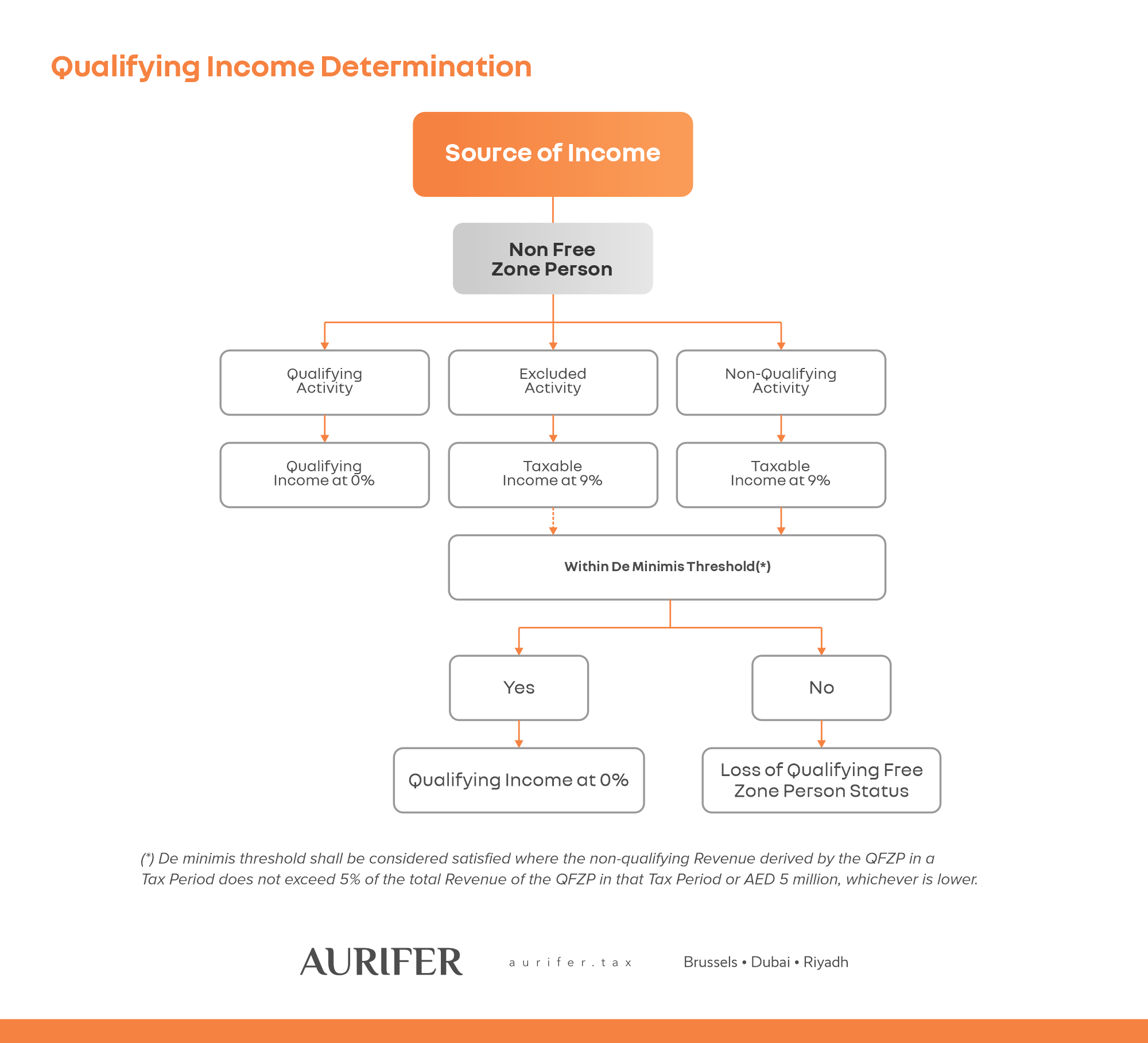
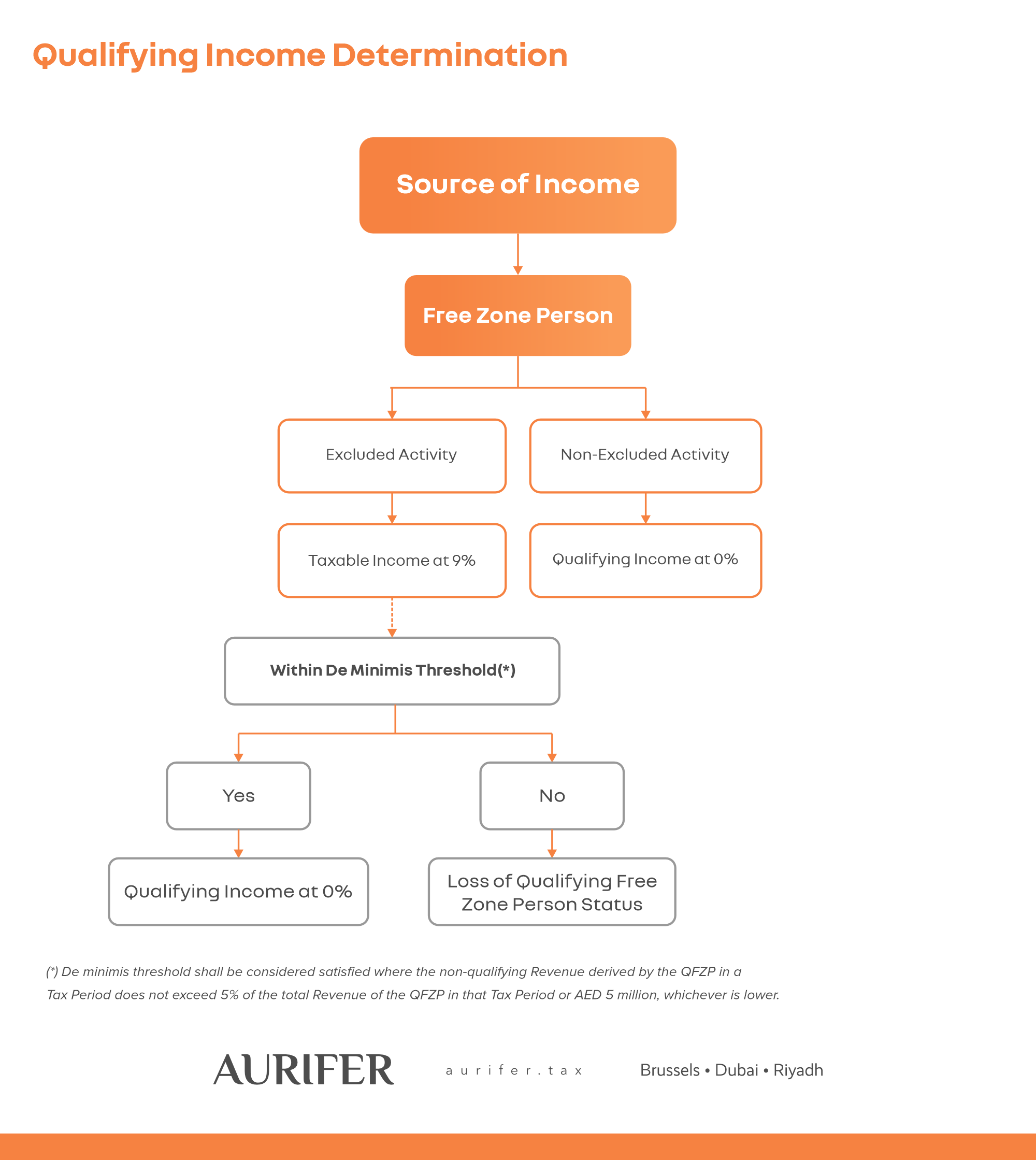
In the context of the new UAE CT Law, Qualifying Income refers to the types of income that are subject to the 0% CT rate. Determining which income is a “Qualifying Income” involves carefully reviewing the types of income, amounts, parties, and transactions involved, as detailed in the charts below.

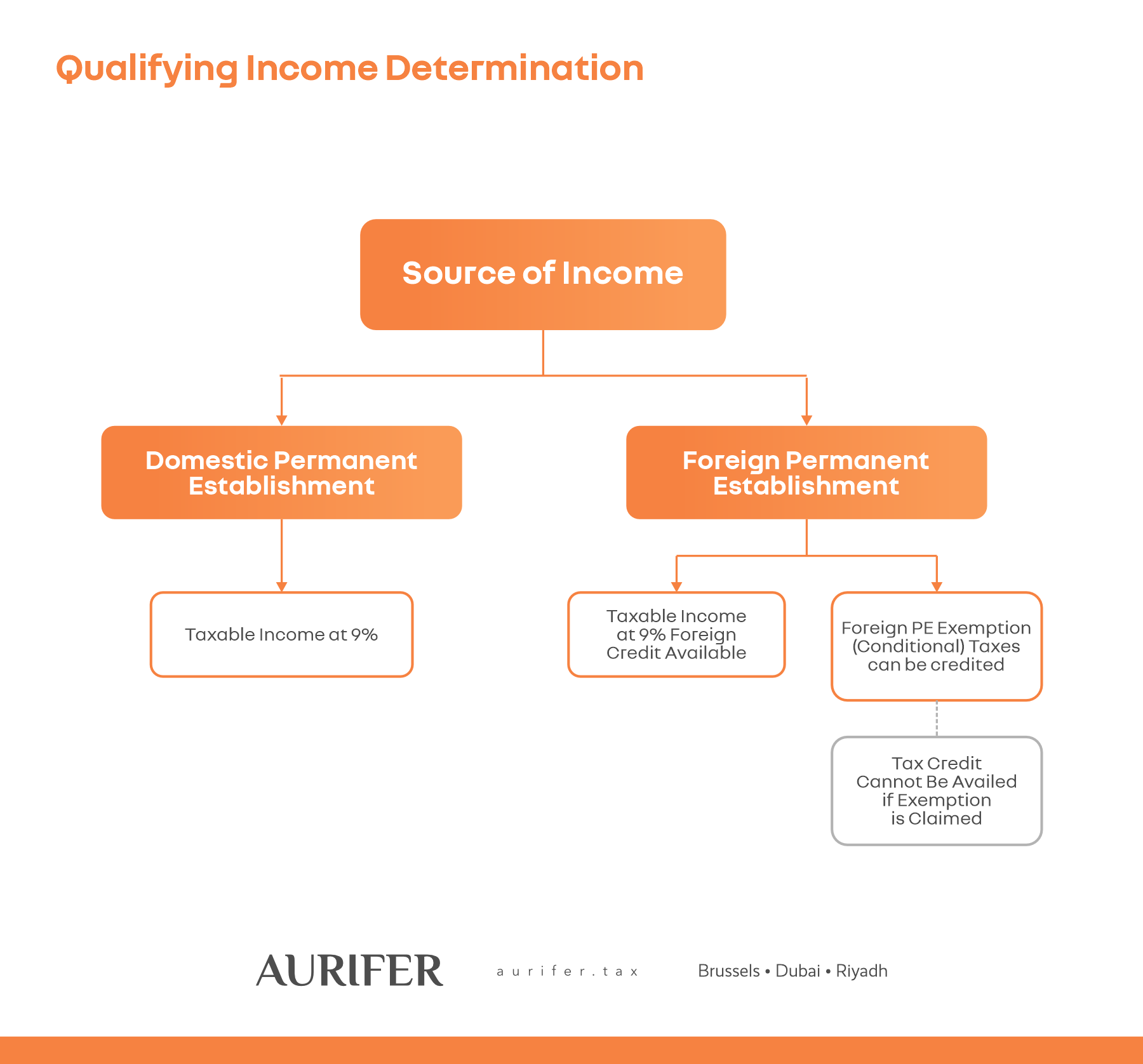
From the above flowchart, the starting point is analyzing the source of income earned by a QFZP, which can arise from the following 4 categories:

1. Income from Non-FZ Person

2.Income from FZ Person

3.Income from Real Estate
– Immovable Property located in a UAE FZ
– Immovable Property Located in UAE Mainland

4. Income from Permanent Establishment
– UAE Permanent Establishment
– Non-UAE Permanent Establishment.

This article will provide a breakdown of each category of the above flowchart and guide you through the flow to determine whether the source of income will ultimately be subject to 9% or 0%.

  • Non-FZ Person

Transactions with Non-FZ Persons refer to income generated from dealings with entities not registered or incorporated within a UAE FZ. The specific conditions and considerations for such transactions need to be thoroughly evaluated.

For income earned by a QFZP from a Non-FZ Person, a distinction to be made is between Qualifying Activities, Excluded Activities and Non-Qualifying (or Non-Excluded) Activities, the latter being a term which is not defined.

– If the source of income arises from a Qualifying Activity of an FZ Person, the income will be considered as Qualifying Income and is subject to 0%.

– If the source of income arises from an Excluded Activity of an FZ Person, the income will be considered Taxable Income and is subject to 9%. However, this is subject to the so-called “De Minimis Requirements” rule, which will be explained further below.

– If the source of income arises from a Non-Qualifying Activity of an FZ Person, the income will be considered as “Taxable Income” and is subject to 9%, which is also subject to the conditions outlined in the “De Minimis Requirements” rule.

So, what is Qualifying Activity? As per Ministerial Decision No. 139 of 2023, Qualifying Activities include a wide range of business activities and services provided to entities located outside of a UAE FZ, including:

  • Manufacturing of goods or materials;
  • Processing of goods or materials;
  • Holding of shares and other securities;
  • Ownership, management and operation of ships;
  • Reinsurance services;
  • Fund management services subject to UAE regulatory oversight;
  • Wealth and investment management services subject to UAE regulatory oversight;
  • Headquarter services to related parties;
  • Treasury and financing services to related parties;
  • Financing and leasing of aircraft, including engines and rotatable components;
  • Distribution in or from a Designated Zone that meets relevant conditions;
  • Logistics services;
  • Any activities ancillary (qualified as such if it has no independent function but is necessary to perform the main Qualifying Activity) to the above activities.

Excluded Activities, on the other hand, are those that are not considered Qualifying Activities and, therefore, cannot benefit from a 0% tax rate, including:

  • Banking activities subject to UAE regulatory oversight;
  • Insurance activities subject to UAE regulatory oversight;
  • Finance and leasing activities subject to UAE regulatory oversight;
  • Ownership and exploitation of immovable property (other than Commercial Property located in an FZ);
  • Ownership and exploitation of intellectual property assets;
  • Any transactions with a natural person, except certain transactions in relation to Qualifying Activities;
  • Any activities ancillary (qualified as such if it has no independent function but is necessary to perform the main Excluded Activity) to the above activities.

Any activity which does not fall under Qualifying Activity and Non-Qualifying Activity is referred to as Non-Qualifying Activity.

If the source of the income is from a Qualifying Activity, it will result in 0% tax on the Qualifying Income derived from the Qualifying Activity. However, if the source of income is from an Excluded Activity or Non-Qualifying Activity (together considered as Non-Qualifying Revenue), the taxable income will be subject to 9%, but it may be possible for the taxable income to be considered Qualifying Income if it fulfils the so-called “De Minimis Requirements” rule.

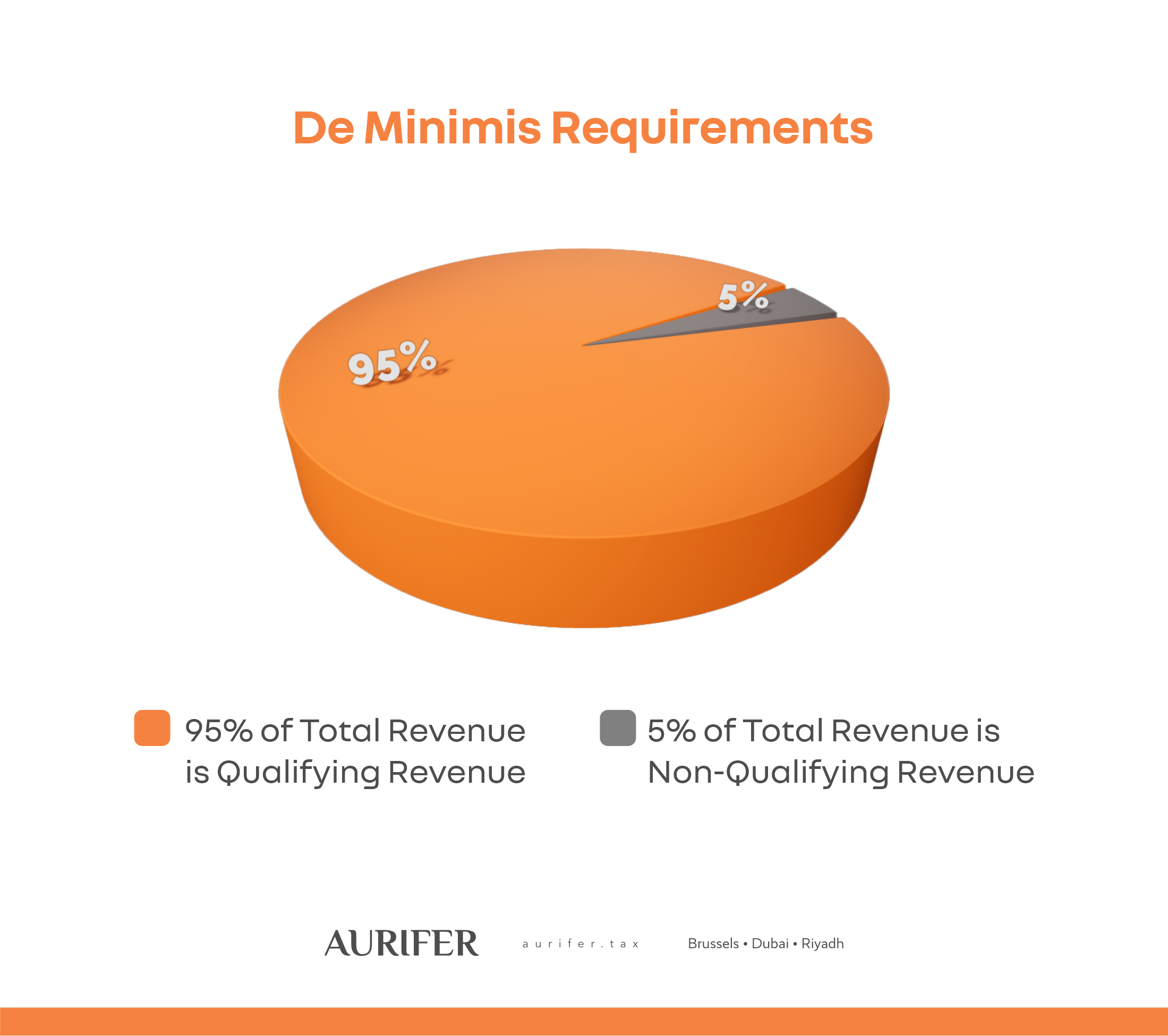
De Minimis Requirements” are fulfilled where Non-Qualifying Revenue derived by a QFZP are:

  • Max 5% of total revenue earned in a tax period by the QFZP;
  • Max AED 5 million of revenue earned in a tax period by the QFZP;

whichever is lower.  

If the Excluded Activity or Non-Qualifying Activity income level is above the “De Minimis Requirements” threshold, then the FZ Person would not be eligible to be treated as a QFZP, and all of its income would be subject to tax at the standard 9% CT rate in the relevant tax period. Such a business would also be excluded from seeking to be treated as a QFZP for the following four tax periods.

  • Free Zone (FZ) Person


For income earned by a QFZP from an FZ Person, the only distinction to be made is between Excluded Activities and Non-Excluded Activities. Excluded Activities are described above.

If the source of income arises from a Non-Excluded Activity of an FZ Person, the income will be considered as “Qualifying Income” and is subject to 0%.

If the source of income arises from an Excluded Activity of an FZ Person, the income will not be considered as Qualifying Income and is subject to 9%.

1.3 Income from Real Estate 

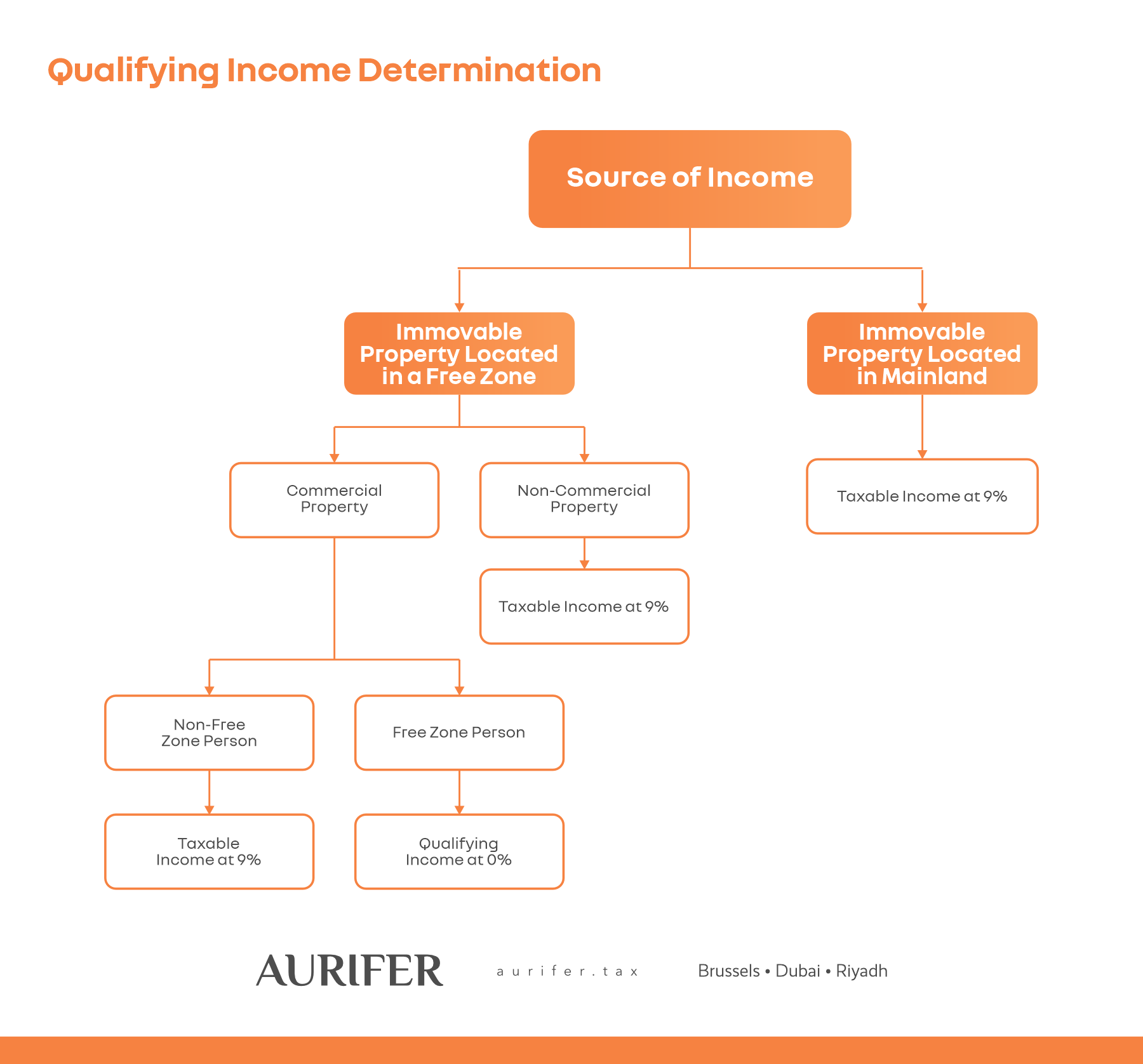
Cabinet Decision No. 55 of 2023 also provides a special tax regime for income attributable to immovable property located in the Free Zone, which we have shown in the chart below:


1.3.1 Immovable property located in a Free Zone

The source of income for an immovable property can be derived from immovable property located in a UAE Free Zone or Mainland and will have different tax treatments.

If the immovable property is located in a Free Zone, there is a demarcation between a Commercial Property and a Non-Commercial Property.

If the transaction of the Commercial Property is with a Non-FZ Person, the income derived from the transaction will be taxable at 9%.

If the transaction of the Commercial Property is with an FZ Person, the income derived from the transaction will be subject to a 0% tax rate.

On the other hand, any transaction or dealing with Non-Commercial Property by any other person will result in the income being taxed at 9%.

This regime may benefit some of the FZ authorities which are also landlords.

1.4 Income from Permanent Establishments

Decision No. 55 of 2023 also addresses revenue from UAE and non-UAE permanent establishments (PEs). This element plays a vital role in shaping the tax landscape for FZ entities, and a thorough understanding is essential for effective tax planning and compliance in UAE Free Zone Corporate Tax Regime.

A PE refers to a place of business or other form of presence as laid down in Article 14 of UAE CT law through which the business of an FZ Person is wholly or partly conducted. The income generated through a UAE or non-UAE PE should be evaluated under specific conditions.

If the source of income is derived from a UAE PE, the income is taxed at 9%.

If the income is derived from a non-UAE PE, the income is also taxable at 9%. However, foreign tax credit may be available.

It is also possible for an FZ Person to elect for having its non-UAE PE income exempt or disregarded for UAE CIT purposes. In such an event, however, no foreign tax credit will be available.

2. Adequate Substance in Free Zones and Outsourcing

For an FZ Person to qualify as a QFZP, it must derive Qualifying Income and maintain adequate substance. The latter requires the QFZP to undertake core income-generating activities within an FZ. Activities that generate the QFZP’s income must be conducted in a UAE FZ, not just managed from there.

The concept of “adequate substance” ties into the UAE’s Economic Substance Regulations, which aim to ensure that businesses genuinely carry out the substantial activity within the UAE rather than being “shell” or “letterbox” companies. The two legislations operate however independently, and there are subtle differences between them.

A QFZP is allowed to outsource activities to a third party or related party in an FZ, provided it maintains adequate supervision. This means that while the QFZP can outsource some of its activities, it must still have sufficient control and oversight over those outsourced activities. This ensures that the QFZP is still considered to be performing the core income-generating activities within an FZ.

Furthermore, to maintain adequate substance, the QFZP must demonstrate the adequacy of the following commensurate to the activities carried out by the FZ Person:

  • Adequate assets;
  • An adequate number of qualified employees;
  • An adequate amount of operating expenditures.

Contrary to the Economic Substance Regulations, there is no directed and managed criterion for the substance requirements.

3. Practical Examples

3.1 Example 1

FZCo1 is a limited liability company that is incorporated, controlled, and managed in the Dubai International Financial Centre (DIFC), a UAE Free Zone. FZCo1 is a holding company of the FZCo1 Group, which includes many companies conducting different types of businesses in and outside the UAE. The company employs a few persons in its headquarters in DIFC, mainly accounting personnel. The company also has different bank accounts and active credit lines with financial institutions in the DIFC. FZCo1 has established a branch in the UAE mainland and another branch in the UAE’s Free Zone of Abu Dhabi Global Market (ADGM).

Result:

FZCo1 is likely to meet the condition of maintaining adequate substance in the UAE to qualify as a (QFZP). It can therefore benefit from 0% UAE Corporate Tax (CT) on the relevant “Qualifying Income” (i.e., “holding of shares and other securities”). The company conducts its core income-generating activities in a UAE’s FZ (i.e., DIFC). It has adequate assets (i.e., headquarters premises), employees (i.e., accounting personnel), and operating expenditures (i.e., as demonstrated through the bank accounts and active credit lines, and other expenses) therein, considering the nature and level of activities performed. Provided that all the other relevant conditions are met, FZCo1’s branch in the UAE’s Free Zone of Abu Dhabi Global Market (ADGM) can also benefit from 0% UAE CT in respect of income attributable to it. FZCo1’s branch established in the UAE mainland is instead subject to 9% UAE CT in respect of income attributable to it.

3.2 Example 2

FZCo2 is a limited liability company that is incorporated, controlled, and managed in the Jebel Ali Free Zone Authority (JAFZA) of the UAE. FZCo2 conducts multiple activities across different business lines. One of its business activities consists of licensing patents and trademarks of pharmaceutical products to other companies in that industry. FZCo2 also owns several commercial properties in JAFZA, which it leases out to FZ and non-FZ persons to conduct business in that UAE’s FZ. Moreover, FZCo2 owns several commercial properties in the UAE mainland, which are rented to FZ and non-FZ Persons to conduct business therein.

Result:

Even if provided that FZCo2 meets all the relevant conditions to be treated as a QFZP, income from the licensing of patents and trademarks of pharmaceutical products is regarded as income from an “Excluded Activity” (i.e., “ownership or exploitation of intellectual property assets”). Therefore, income from such an Excluded Activity cannot benefit from 0% UAE CT but is subject to the standard 9% UAE CT rate, despite the activity being conducted in a UAE’s FZ (i.e., JAFZA).

As regards income from the lease of immovable property, a distinction must be drawn depending on the type, location and other party involved in the relevant transaction. Only income from the lease of commercial property by FZCo2 in an FZ (i.e., JAFZA), where the other party is also an FZ Person, can benefit from a 0% UAE CT rate. In all other instances, the standard 9% UAE CT rate applies.


4. Other Considerations for a Qualifying Free Zone

Other key considerations associated with qualifying for a FZ person and their implications for businesses are as follows:

  • Elective taxation at 9%;
  • Elective taxation at 9% effective from the commencement of the tax period in which election is made; (or)
  • Commencement tax period following the tax period in which the election was made;
  • Cannot be a member of Tax Group;
  • Cannot transfer/offset losses to/from taxable (related) persons;
  • Participation Exemption applies in relation to income from QFZP (subject to conditions);
  • Must file a tax return;
  • May be required to file disclosure form along with tax return (to be notified by Authority);
  • Must prepare and maintain audited financial statements;

5. Our Take 

The newly issued Cabinet Decision No. 55 of 2023 and Ministerial Decision No. 139 of 2023 have provided much-needed clarity to the UAE Corporate Tax framework, particularly for FZ Persons. These decisions have brought forth specific definitions for Qualifying Income, Qualifying Activities, and Excluded Activities, thereby setting clear parameters for tax obligations for businesses operating within one of the more than 40 multidisciplinary UAE FZs. It is also worth mentioning that the guidelines concerning the so-called De Minimis Requirements for maintaining adequate substance have been detailed.

The scope of the 0% UAE CT rate appears to be narrower than initially anticipated, potentially reducing the UAE’s attractiveness as a tax-friendly business jurisdiction. Moreover, the Qualifying Activities do not seem to encompass all the activities businesses may undertake with third countries, potentially limiting the scope of the 0% rate. Financial services, which are traditionally exempt from tax in many FZ jurisdictions when “exported”, are also included in the list of “Excluded Activities”. This could have substantial implications for the financial sector and potentially discourage financial institutions from operating in UAE FZs.

The rationale behind excluding certain activities from the Qualifying Activities list is unclear and could benefit from further clarification. The original purpose of establishing FZ’s was to facilitate export-related income; however, it is important to note that not all activities conducted with third countries fall under this category. Certain services, such as professional consultancy, legal, tax, administrative, along with software development and leasing of non-aircraft assets, are notably excluded from the scope of Free Zone activities focused on export.

Furthermore, businesses and stakeholders must keep an eye on future developments and changes to these laws and regulations as the UAE government continues refining its corporate tax framework. It will be crucial for businesses to monitor these changes closely to ensure that they remain compliant and can effectively manage their tax obligations in the UAE. It is likely that the Ministry of Finance and the FTA’s position on some of the matters might evolve or be clarified.

If you wish to understand the UAE Corporate Tax on Qualifying Free Zone Persons easily, we have simplified the essential information under this topic through this informative animated video.

Categories
UAE Tax

CIT in the UAE: The PE Clause for Individuals

CIT in the UAE: The PE Clause for Individuals

  1. Introduction

The United Arab Emirates (UAE) announced the introduction of a Corporate Taxation (CT) regime on 31 January 2022. On 9 December 2022, the Ministry of Finance (MoF) of the UAE published Federal Decree-Law No. 47 of 2022 (UAE CT Law), issued on 3 October 2022, after a public consultation process initiated on 28 April 2022. UAE CT Law applies only to business profits – i.e., no personal income tax is levied on other types of income such as proceedings from real estate, employment or private investment and savings earned in a personal capacity.

The UAE CT Law has been effective since 25 October 2022, and a UAE CT liability applies for financial years starting on or after 1 June 2023. The UAE CT Law is also complemented by several implementing decisions to be adopted by the UAE Cabinet, the UAE Ministry of Finance (MoF) and the UAE Federal Tax Authority (FTA). Only a minor part of this detailed legislation has been issued at the time of writing.

Some of the main objectives for implementing the UAE CT regime are:

  1. Cementing the UAE’s position as a world-leading hub for business and investment.

  2. Meeting international standards for tax transparency and preventing harmful tax practices.

  3. Accelerating the UAE’s development and transformation to achieve its strategic objectives.

Overall, the UAE CT Law is designed relatively straightforwardly and aims to be as business friendly as possible. It applies a relatively moderate headline rate of 9% on business profits above AED 375,000 (i.e., USD 100,000). There is also a separate rate of 0% on ‘Qualifying Income’ earned by ‘Qualifying Free Zone Persons’, which applies to Free Zone companies. Details on what constitutes ‘Qualifying Income’ are expected to be released through a UAE Cabinet Decision soon.

Further, the UAE CT Law has incorporated, where possible, recommendations and best practices from the 2013-15 BEPS project (e.g., the 30% EBITDA interest deduction limitation from BEPS Action 5 and the Principal Purpose Test (PPT) under BEPS Action 6).

Remarkably, there is no direct reference under UAE CT Law itself to the OECD/G20-Inclusive Framework BEPS Project, which involves the implementation of a Global Minimum Tax, otherwise known as ‘Pillar Two’. The only indication towards adopting Pillar Two can be read in the UAE MoF FAQs, where the UAE reiterated its commitment to the Inclusive Framework to adopt the proposal in due course.

Overall, the UAE CT implements a worldwide taxation system for entities with tax residency in the UAE. For non-resident entities, the UAE CT has sourcing rules and definitions of what constitutes a Permanent Establishment (PE). Those sourcing rules give the UAE the right to tax certain transactions which have a link with the UAE. Those transactions would usually be taxed by way of a withholding tax. However, Article 45 of UAE CT Law has provided it will only apply a 0% withholding tax with no reporting obligations.

  1. PE Definition under UAE CT Law

When a business activity of a non-UAE resident enterprise amounts to a certain threshold of presence or activity in the UAE, the PE definition becomes crucial. Non-UAE resident businesses with a PE in the UAE are subject to 9% UAE CT on the profits allocated to that PE.

In the previous article, the authors discussed the PE concept under UAE CT Law and contrasted this definition with international tax principles. This article deals with the PE concept applied to individuals operating as solo entrepreneurs or freelancers (including investment managers) in the UAE territory. In particular, the authors discuss when an individual physical presence and/or a home office in the UAE may qualify as a PE under UAE CT Law.

  1. Article 14(7) of UAE CT Law

Besides establishing when a fixed place of business or a non-independent agent acting on behalf of a non-resident enterprise qualify as a PE in the UAE, the PE definition in Article 14 of UAE CT Law considers, under Clause 7, whether and when the physical presence of an individual in the UAE territory may lead to a foreign enterprise having a PE therein.

Notably, Clause 7 of Article 14 of UAE CT Law stipulates that ‘[f]or the purposes of Clause 3 of this Article [i.e., Article 14 of UAE CT Law], the Minister may prescribe the conditions under which the mere presence of a natural person in the State does not create a Permanent Establishment for a Non-Resident Person …’.

The provision in Article 14(7) of UAE CT Law is neither part of any ‘standard’ PE definition under national CT laws nor included in Article 5 of the OECD Model Convention (OECD MC) or the UN Model Convention (UN MC). The exact scope of this provision is somewhat vague, also given that its actual coverage is explicitly made subject to a future determination by a UAE MoF’s Cabinet Decision. A systematic interpretation of Clause 7 of Article 14 of UAE CT Law (in light of other Clauses within Article 14 of UAE CT Law) would suggest reading it in parallel with Point c) of Clause 1 of Article 14 of UAE CT Law. From this perspective, Clause 7 of Article 14 of UAE CT Law might be read as designating when the mere presence of an individual does not amount to ‘any other form of nexus’ in the UAE, as stipulated under Point c) of Clause 1 of Article 14 as a third type of PE under UAE CT Law.

There are, however, a few elements of Clause 7 of Article 14 of UAE CT Law which already appear sufficiently explained:

  1. Clause 7 applies only to natural persons, i.e., individuals. It follows that companies or other legal entities are not affected by this provision. On the other hand, one may wonder whether unincorporated partnerships may somehow fall within the scope of this provision since, under Articles 16 of UAE CT Law, these legal entities may not be considered taxable persons of their own rights, but instead their partners assume UAE CT liability on their behalf.

  2. Clause 7 explicitly refers and, therefore, must be read jointly with Clause 3 of Article 14 of UAE CT Law concerning the list of specific activities whose carrying on through a fixed place of business is insufficient to constitute a PE. The rationale behind excluding any relevance of such activities for PE purposes is likely to be found in the OECD MC Commentary, which, in paragraph 58, stipulates that the analogous exclusionary list under Article 5(4) of the OECD MC relates to activities which only contribute marginally to the profits of the enterprise, i.e., ‘are so remote from the actual realisation of profits that is difficult to allocate any profit to the fixed place of business in question’.

  3. Clause 7 establishes no link to Clause 5 of Article 14 of UAE CT Law concerning the personal PE. Therefore, it can be assumed that a person habitually concluding or negotiating contracts on behalf of a Non-Resident Person always constitutes a PE, without any possibility for such an activity to be excluded under Clause 7 of Article 14 of UAE CT Law. Clause 7 of Article 14 might be of concern also to an investment manager in case anyof the conditions to be considered an ‘independent agent’ under Clause 6 of Article 14 of UAE CT Law, as detailed explicitly in Article 15 of UAE CT Law, are not fulfilled. This is because, in case any of the conditions for the ‘Investment Manager Exemption’ (IME) to apply, according to Article 15 of UAE CT Law, are not fulfilled, whether the investment manager triggers a PE for a foreign investment fund is to be checked against all the clauses of Article 14 of UAE CT Law and, in particular, Clause 7 of that Article, concerning the ‘mere presence of a natural person’.

  4. Applying Article 14(7) of UAE CT Law to the Case of an Individual Physically Present in the UAE

Since Clause 7 of Article 14 of UAE CT Law refers to ‘any of the following instances’, the cases under which the mere presence of an individual in the UAE does not constitute a PE as detailed in Points a) and b) appear to be alternative (contrary to the subparagraphs 1) and 2) under Point b), which instead refer to ‘all of the following conditions’). Therefore, the PE exclusion applies even if only one of the requirements specified in any of the two subparagraphs of Clause 7 is fulfilled.

Point a) of Clause 7 of Article 14 of UAE CT Law sets forth a PE exclusion in the case of the mere presence of a natural person being ‘a consequence of a temporary and exceptional situation’. Arguably, this exclusion only applies in limited circumstances, such as the one that occurred during the outbreak of COVID-19 in 2020-21, where many employees were stranded in locations other than where they used to live and/or work. The authors also note that the expression used under Point a) of Clause 7 of Article 14 of UAE CT Law is somewhat comparable to that of ‘exceptional circumstances’ used for counting the days of physical presence leading to the tax residence of a natural person in the UAE.

Point b) of Clause 7 of Article 14 of UAE CT Law is only applicable to an individual who is employed by a foreign enterprise. However, how the concept of ‘employee’ should be interpreted is not (yet) specified. In this connection, one may wonder whether only a formal relationship of employment is acknowledged or, instead, this provision might also apply in cases of international hiring-out-of-labour (IHOL), where, following a substance-over-form approach, the ‘real’ employer might differ from the ‘formal’ employer. The authors also note that a definition of ‘employment’ for tax residency purposes is provided by a decision issued by the UAE FTA on 1 March 2023. And yet, the definition contained in that decision does not refer to the concept of ‘employment’ under Article 14 of UAE CT Law, so the interpretive value of that expression for PE purposes cannot simply be assumed.

Subparagraph 1 of Point b) of Clause 7 of Article 14 of the UAE CT Law refers to ‘core income-generating activities of the Non-Resident Person or its Related Parties’. This expression, as well as Clause 7 in general, is not included in either the OECD MC or the UN MC. Reference to ‘core income-generating activities’ suggests the need to determine whether business activities conducted in the UAE territory have a preparatory or auxiliary character. In this regard, the OECD MC Commentary provides that, in order ‘to distinguish between activities which have a preparatory or auxiliary character and those which have not’, ‘[t]he decisive criterion is whether or not the activity of the fixed place of business in itself forms an essential and significant part of the activity of the enterprise as a whole’. The authors also note that the UAE MoF’s Economic Substance Requirements (ESRs) resolution contains an identically worded expression. One may therefore wonder whether such an identical wording implies that the carrying out of any of the activities within the scope of ESRs always triggers a PE in the UAE.

  1. Applying Article 14(7) of UAE CT Law to the Case of a ‘Home Office PE’ in the UAE

The actual business operations carried out in the UAE vis-a-vis the overall business activity of a foreign enterprise might also be critical to determine the existence of a PE in the UAE in the form of a ‘home office’. This occurs when the employee physically present in the UAE uses a home therein in lieu of an office so that such a private dwelling in the UAE can be considered at the disposal of the foreign employer of the individual who lives there. Actual relocations in the UAE might eventually be facilitated by applications for a special residence visa by foreign employees moving to the UAE territory or the city of Dubai while retaining employment in their respective foreign countries.

Regarding the case of a ‘home office PE’ in the UAE, the authors would advise that the clarifications to be released by the UAE MoF under Clause 7 of Article 14 of UAE CT Law for ‘core income-generating activities’ help determine when activities carried out at a private dwelling of an employee (e.g., a hotel room) amounts to a PE, such activities not being instead ‘merely auxiliary’. In this connection, the authors are of the view that no home office PE should be triggered when an employee’s activities performed in the UAE are not aimed at the UAE market or customers. On the other hand, it must be recalled that the circumstance that business activities performed by an individual through his/her presence in the UAE are not part of the ‘income-generating activities’ of a foreign enterprise is, by itself, insufficient to exclude the existence of a PE in the UAE. This is because of the operation of the anti-fragmentation rule in Clause 4 of Article 14 of UAE CT Law in the case of business activities by two or more parties which are linked to one another.

Subparagraph 2 of Point b) of Clause 7 of Article 14 of UAE CT Law also requires that ‘[t]he Non-Resident Person does not derive State Sourced Income’. This condition might prove difficult to escape from a foreign enterprise considering the broad scope attributed to ‘State Sourced Income’ under Article 13 of UAE CT Law. Notably, this provision sourced in the UAE not only services performed but even services ‘benefitted’ in the UAE territory. Moreover, Clause 2 of Article 13 includes a broad list of ‘State Sourced Income’, some of which, arguably, have only a weak nexus with the UAE, such as ‘income from a contract insofar as it has been wholly or partly performed or benefitted from in the State’ or ‘income from the use or right to use in the State, or the grant of permission to use in the State, any intellectual or intangible property’. In this connection, it is also unclear whether a natural person might constitute a PE for a foreign enterprise even if the State Source Income derived by the foreign enterprise is unrelated to the specific activities the employee performs in the UAE.

  1. Conclusions

UAE CT Law and the PE clause contained in Article 14 therein have been designed to adopt international tax best practices. In this regard, the PE clause in UAE CT Law generally follows the corresponding provisions in Article 5 of OECD and UN MCs and explanations provided in the related Commentaries. However, applying and interpreting the concepts and definitions contained in Article 14 of UAE CT Law is not always straightforward. This article has focused on the implications of the PE clause for individual entrepreneurs and freelancers (including investment managers). It has shown that, in certain instances, based on Article 14(7) of UAE CT Law, individuals may trigger a PE in the UAE if they are physically present or have a home office therein. Individual entrepreneurs and freelancers (including investment managers) should therefore examine attentively whether and when their activities and/or presence may trigger the UAE PE clause and, consequently, a UAE CT liability.


For Thomas Vanhee and Varun Chablani: The views expressed in this article are sole of the authors and do not necessarily reflect the position of the employers or the parties with which the authors are affiliated.

For Giorgio Beretta: This work has been developed within the framework of the Amsterdam Centre for Tax Law (ACTL) research project “Designing the tax system for a cashless, platform-based and technology-driven society” (CPT project). The CPT project is financed with university funding and funds provided by external stakeholders (i.e., businesses and governments) interested in supporting academic research to design fair, efficient and fraud-proof tax systems. For more information about the CPT project and its partners, please visit its website https://actl.uva.nl/cpt-project/cpt-project.html. The usual disclaimers apply. 


Categories
UAE Tax

CIT in the UAE: The PE Clause for Companies

CIT in the UAE: The PE Clause for Companies

1. Introduction

The United Arab Emirates (UAE) announced the introduction of a Corporate Taxation (CT) regime on 31 January 2022. On 9 December 2022, the Ministry of Finance (MoF) of the UAE published Federal Decree-Law No. 47 of 2022 (UAE CT Law), issued on 3 October 2022, after a public consultation process initiated on 28 April 2022. The UAE CT Law applies only to business profits – i.e., no personal income tax is levied on other types of income such as proceedings from real estate, employment or private investment and savings earned in a personal capacity.

The UAE CT Law has been effective since 25 October 2022, and the CT liability applies for financial years starting on or after 1 June 2023. The UAE CT Law is also complemented by several implementing decisions to be adopted by the UAE Cabinet, the UAE Ministry of Finance (MoF) and the UAE Federal Tax Authority (FTA). Only a minor part of this detailed legislation has been issued at the time of writing.

Some of the main objectives for implementing the UAE CT regime are:

  1. Cementing the UAE’s position as a world-leading hub for business and investment.
  2. Meeting international standards for tax transparency and preventing harmful tax practices.
  3. Accelerating the UAE’s development and transformation to achieve its strategic objectives.

Overall, the UAE CT Law is designed relatively straightforwardly and aims to be as business friendly as possible. It applies a relatively moderate headline rate of 9% on business profits above AED 375,000 (i.e., USD 100,000). There is also a separate rate of 0% on ‘Qualifying Income’ earned by ‘Qualifying Free Zone Persons’, which applies to Free Zone companies. Details on what constitutes ‘Qualifying Income’ are expected to be released through a Cabinet Decision soon.

Further, the UAE CT Law has incorporated, where possible, recommendations and best practices from the 2013-15 BEPS project (e.g., the 30% EBITDA interest deduction limitation from BEPS Action 5 and the Principal Purpose Test (PPT) under BEPS Action 6).

Remarkably, there is no direct reference under UAE CT Law itself to the OECD/G20-Inclusive Framework BEPS Project, which involves the implementation of a Global Minimum Tax, otherwise known as ‘Pillar Two’. The only indication towards adopting Pillar Two can be read in the UAE MoF FAQs, where the UAE reiterated its commitment to the Inclusive Framework to adopt the proposal in due course.

Overall, the UAE CT implements a worldwide taxation system for entities with tax residency in the UAE. For non-resident entities, the UAE CT has sourcing rules and definitions of what constitutes a Permanent Establishment (PE). Those sourcing rules give the UAE the right to tax certain transactions which have a link with the UAE. Those transactions would usually be taxed by way of a withholding tax. However, Article 45 of UAE CT Law has provided it will only apply a 0% withholding tax with no reporting obligations.

2. PE Definition under UAE CT Law

When a business activity of a non-UAE resident enterprise amounts to a certain threshold of presence or activity in the UAE, the PE definition becomes crucial. Non-UAE resident businesses with a PE in the UAE are subject to 9% UAE CT on the profits allocated to that PE.

This article discusses the PE concept under UAE CT Law and contrasts this definition with international tax principles. In the article, the authors analyse the UAE’s PE policy and approach with a few practical examples, focusing on applying the PE clause to companies and other legal entities. The operation of the so-called ‘Separate Entity Approach’ for allocating profits between the head office (HO) and the PE is not addressed.

3. Article 14 of UAE CT Law

UAE CT Law provides a definition of PE under Article 14. The PE definition under UAE CT Law shows similarities and differences with the related concepts in the OECD Model Tax Convention on Income and Capital 2017 (OECD MC) and the United Nations Model Double Taxation Convention between Developed and Developing Countries 2017 (UN MC). Notably, UAE CT Law develops a preference for the PE definition under the OECD MC, with some deviations.

Article 14(1) of UAE CT Law sets forth the instances where a non-resident is considered to have a PE in the UAE, i.e., where, alternatively:

  1. A non-resident person has a fixed or permanent place in the UAE through which the business of the non-resident or any part thereof is conducted (commonly known as ‘Fixed Place PE’, also including the so-called ‘Construction PE’).
  2. A Person has and habitually exercises an authority to conduct a business or a business activity in the UAE on behalf of the non-resident person (commonly known as ‘Agency PE’).
  3. Where a non-resident person has any other form of nexus in the UAE (to be specified in a UAE MoF’s Cabinet Decision).

4. Comparing the PE Definition under UAE CT Law with the OECD and UN MCs Approaches

Article 14(1)(a) and (2) of UAE CT Law delineates the so-called ‘Fixed PE’, while Article 14(1)(b) and (5) of UAE CT Law lay down the so-called ‘Agency PE’. Both types of PEs closely follow the corresponding definitions under Article 5 of the OECD MC. Nevertheless, some different nuances between the PE definitions under UAE CT Law and the OECD MC can be noted.

4.1. Fixed PE under UAE CT Law and the OECD MC

Article 14(2) of the UAE CT Law contains eight instances of fixed PEs. In general, Article 14(2) of UAE CT Law mirrors Article 5(2) of the OECD MC, except in the situations below:

  1. The term ‘place of management’ under UAE CT Law also covers the following words, ‘where management and commercial decisions that are necessary for the conduct of the Business are, in substance, made’. The authors submit that this wording under UAE CT Law – in particular, a reference not only to ‘management’ but also to ‘commercial’ decision – might suggest that not the place of ‘management and control’ but that of ‘effective management’ of the business should be considered, i.e., the place where the day-to-day management decisions of the business are routinely taken.
  2. UAE CT Law includes the expression ‘land, buildings and other real property’. This expression is not found in either the OECD or the UN MCs. However, it is unclear whether the expression ‘land, buildings or other real property’ marks an effective departure from the corresponding provision under the OECD and UN MCs or is merely clarificatory.
  3. The so-called ‘Construction PE’, while separately listed in Article (14)(2)(i) of UAE CT Law as one of the instances of a fixed PE, deserves some attention, given that it includes a duration of 6 months, unlike the other types of fixed PEs. This duration is shorter than the Construction PE under the OECD MC, which prescribes a 12-month period. Instead, the 6-month threshold is used under the UN MC.

4.2. Exceptions to a ‘Fixed Place PE’ under UAE CT Law and the OECD MC

Article 14(3) of UAE CT Law contains a list of activities which, taken in isolation, do not amount to a PE, similarly to the exclusionary provision under Article 5(4) of the OECD MC. The scope of this exclusionary provision involves situations, where, notably, certain activities are conducted in isolation and are of a ‘preparatory’ or ‘auxiliary’ nature.

In detail, the coverage of Article 14(3) of UAE CT Law mirrors that of Article 5(4) of the OECD MC, except in the situations below:

  1. UAE CT Law does not have a provision equivalent to ‘[m]aintenance of a stock of goods or merchandise belonging to the enterprise solely for the purpose of storage, display or delivery’, as laid down in Article 5(4)(b) of the OECD MC.
  2. OECD MC uses the term ‘[m]aintenance of a fixed place of business solely for the purpose of carrying on, for the enterprise, any other activity’, while Article 14(3)(d) of UAE CT Law has a slightly broader wording, i.e., ‘conducting any other activity of a preparatory or auxiliary nature for the non-resident person’.
  3. OECD MC covers the term as ‘[m]aintenance of a fixed place of business solely for any combination of activities above provided that the overall activity is of a preparatory or auxiliary nature’, while Article 14(3)(e) of UAE CT Law has a slightly broader wording, i.e., ‘[c]onducting any combination of activities mentioned in paragraphs (a), (b), (c) and (d) of Clause 3 of this Article, provided that the overall activity is of a preparatory or auxiliary nature’.

Overall, the scope of the exclusionary provision under the PE definition of Article 14(3) of UAE CT Law seems slightly broader than that of Article 5(4) of the OECD MC. Therefore, a non-resident person may benefit from the PE exclusionary clause in more situations than based on the corresponding provision under the OECD MC.

4.3. Comparing the Anti-Fragmentation Rule under Article 14(4) of UAE CT Law and Article 5(4.1) of OECD MC

Article 14(4) of UAE CT Law provides an exception to Article 14(3) of UAE CT Law (effectively, an exclusion to the exception to the UAE general rule for PE).

The core of the provision is that the exception under Article 14(3) of UAE CT Law does not apply, so a PE exists in the UAE, if all of the following four requirements are fulfilled:

  1. A fixed or permanent place in the UAE is used or maintained by a non-resident.
  2. The same non-resident or its Related Party carries on a Business or a Business Activity at the same place or another place in the UAE.
  3. The same place or the other place constitutes a PE for either the non-resident or its Related Party.
  4. The ‘overall activity’ resulting from the combination of the activities carried out by the non-resident and its related party at the same place or at the two places is not of a preparatory or auxiliary nature. Such overall activity would form a ‘cohesive business operation’, had the activities not been fragmented.

The mirror provision in the OECD MC is laid down in Article 5(4.1.), which refers to the term ‘or’ (i.e., disjunctive) when delineating the requirements under (iii) and (iv) above. On the other hand, UAE CT Law uses the term ‘where all of the following conditions are met’ (i.e., conjunctive, equivalent to ‘and’). This might suggest that, for the exclusion of the PE exception to apply under UAE CT Law, both the conditions under (iii) and (iv) above must be jointly fulfilled.

The difference is material. Take the situation of a company, Alpha, based in the United States, with which the UAE does not have a tax treaty. It has a closely related enterprise in the United States, Beta. Both companies are part of ‘AB Group’. Alpha maintains a place of business ‘A’ in the UAE. Beta also maintains a place of business ‘B’ in the UAE. In A, the sole activity of invoicing is performed. In B, the sole activity of account reconciliation is performed. Both A and B individually do not constitute a PE of the respective non-resident companies, their activities being merely ‘preparatory’ and ‘auxiliary’ within the meaning of Article 14(3) of UAE CT Law. When viewed together, the activities of A and B form a ‘cohesive business operation’, since the combined finance function of invoicing and account reconciliation can no longer be holistically considered ‘preparatory’ or ‘auxiliary’. And yet, the anti-fragmentation rule under Clause 4 of Article 14 of UAE CT Law cannot apply since none of the two fixed places is of ‘a preparatory of auxiliary nature’ as prescribed under point b) of that Article.

4.4. Comparing the ‘Agency PE’ and ‘Independent Agent’ Concepts under Article 14(5) of UAE CT Law and Article 5(5) of OECD MC

As explained above, Article 14(1)(b) delineates the ‘Agency PE’ concept along with Article 14(5) of UAE CT Law. These two provisions fundamentally reflect Article 5(5) of the OECD MC.

Essentially, Article 14(5) of UAE CT Law provides that the so-called ‘Agency PE’ is triggered if either of the conditions is met:

  1. The Person habitually concludes contracts on behalf of the non-resident.
  2. The Person habitually negotiates contracts that are concluded by the non-resident, without the need for material modification by the non-resident.

Article 5(5) of the OECD MC also provides these two alternative conditions. The only meaningful difference between the two systems is that UAE CT Law does not refer to the type of contracts, as covered under both the OECD and UN MCs. Also, UAE CT Law does not include the additional clause under Article 5(5)(b) of the UN MC, i.e., ‘habitual maintenance of stock of goods from which the person regularly delivers goods or merchandise on behalf of the enterprise.

An exception to the PE rule is the ‘Independent Agent’ concept covered under Article 14(6) of UAE CT Law. Under this provision, a PE is not triggered when the agent resident in the UAE performs certain activities for the non-resident in the ‘ordinary course’ of its own Business or Business Activity. This is because such an agent’s activities represent a separate and independent enterprise.

Article 14(6) of UAE CT Law also significantly mirrors Article 5(6) of the OECD MC. The only meaningful difference is that the OECD MC also refers to ‘closely related’ enterprises. The distinction is nuanced. The OECD MC excludes from the scope of the ‘independent agent’ provision the case in which the person acting (almost) exclusively on behalf of ‘one or more enterprises that are closely related’. This exclusion of ‘closely related’ enterprises is missing in UAE CT Law.

Importantly, Clause 6 of Article 14 of UAE CT Law also becomes relevant in relation to Article 15 of UAE CT Law, which lays down the so-called ‘Investment Manager Exemption’ (IME). This clause – which is not contained in the OECD or UN MCs but only under the PE definition of some countries – provides a series of conditions based on which, if all are fulfilled, ‘an Investment Manager shall be considered an independent agent when acting on behalf of a Non-Resident Person’.

4.5. Article 14(1)(c) of UAE CT Law: A Nexus or Service PE?

Based on Article 14(1)(c) of UAE CT Law, a PE can also be established on a non-resident person having ‘any other form of nexus’ in the UAE. A UAE MoF’s Cabinet Decision is expected to provide additional details on the scope of this provision. Even though it is not expressly stated so far, the open-ended nature of this provision may allude to a possible expansion to other types of PEs, such as a Service PE (inspired by Article 5(3)(b) of the UN MC) or an Insurance PE (inspired by Article 5(6) of the UN MC) both types of PEs laid down in the UN MC. The expression ‘any other form of nexus’ could also be linked with Clause 7 of Article 14 of UAE CT Law, detailing the ‘conditions under which the mere presence of a natural person in the State does not create a permanent establishment for a Non-Resident Person’. A forthcoming blog from the authors of this blog will discuss the scope and issues relating to Clause 7 of Article 14 CT Law.

5. Conclusion

This article has shown how the PE policy under UAE CT Law must still be fully ‘decodified’. The authors believe that implementing decisions to be adopted by the UAE Cabinet, the UAE MoF, and the UAE FTA will help shed some light on (still) unclear elements of the PE policy under UAE CT Law. Meanwhile, businesses operating in the UAE should rely on qualified interpretation by tax experts to fill in other (non-)intended legislative blind spots. Also, other than the PE Clause under UAE CT, businesses should include the examination of tax treaty provisions applicable to their individual situation in their PE analysis.


For Thomas Vanhee and Varun Chablani: The views expressed in this article are sole of the authors and do not necessarily reflect the position of the employers or the parties with which the authors are affiliated.

For Giorgio Beretta: This work has been developed within the framework of the Amsterdam Centre for Tax Law (ACTL) research project “Designing the tax system for a cashless, platform-based and technology-driven society” (CPT project). The CPT project is financed with university funding and funds provided by external stakeholders (i.e., businesses and governments) interested in supporting academic research to design fair, efficient and fraud-proof tax systems. For more information about the CPT project and its partners, please visit its website https://actl.uva.nl/cpt-project/cpt-project.html. The usual disclaimers apply.

Categories
GCC Tax UAE Tax

Working remotely tax free – not that simple

Working remotely tax free – not that simple

The Government of Dubai launched a virtual working program for overseas employees wishing to relocate to Dubai whilst retaining employment in their respective countries. This program aims to enable individuals to utilize the economical and tax advantages associated with residing in Dubai, despite being employed in their countries. 

While seemingly very attractive, unfortunately it is not that easy for these employees to ensure that their salary will be tax free. In addition, every case may be different. Of course the UAE does not impose Personal Income Tax, but that does not mean that the other jurisdiction will let go that easily.

One can broadly distinguish the following scenarios: 


Scenario 1: No Double Taxation Treaty in place between UAE and country of employment 

Nothing shall prevent the application of the Personal Income Tax Law of the country of employment. That country shall retain the right to tax the person on his employment income (but may choose not to tax the employment income).  

E.g.: Jim is a US Citizen and and is employed by USCO. He decides to work from Dubai. The US tax authority still has the right to tax Jim.

Scenario 2: Double Tax Treaty in place between UAE and country of employment or tax residency and person does not qualify as tax resident in UAE

A non-resident in the UAE which is employed by a non UAE entity would still be taxed on his income in the state of his residence. Under the treaty, the country of residence would be obliged to provide double tax relief for taxes paid in the UAE. Even though the UAE has a primary right to tax, due to the fact that it does not tax employment income, the state of residence retains the right to tax the income of the employee. 

As an exception, in cases where the country of employment applies an exemption system, the person may not pay tax in the country of residence and exercise his employment tax-free in the UAE.   

E.g.: Roberto is a tax resident of country A, employed by a company incorporated in country A. Roberto moved to Dubai in December 2020 to benefit from the virtual working scheme. Roberto is not a resident in the UAE for tax purposes and is not aiming to be a resident in the UAE for the near future. 

The Double Tax Agreement between country A and the UAE applies the credit method to eliminate double taxation, which entails that country A shall deduct from the taxes calculated, the Income Tax paid in the UAE. As there is no Income Tax in the UAE, country A shall request the tax due in totality and fully retain its right to tax. 

The situation would differ if Roberto is a tax resident of country B and relocates to Dubai, and the Double Taxation Agreement between the UAE and country B applies an exemption method. Under the exemption system, any income which may be taxed by the UAE will be exempt from tax in country B. In the absence of the conditional subject to tax rule, the exemption system would effectively allow Roberto to escape the burden of Personal Income Tax in Country B, and pay no taxes in the UAE.

Scenario 3: Double Taxation Treaty in place between UAE and country of employment and the person qualifies as tax resident in the UAE. 

This situation may lead to a so-called Dual Residency issue, where two jurisdictions consider a person a tax resident. Given that the person in our assumption qualifies as a tax resident in UAE in addition to being a resident in his country of employment as well, the tie-breaker rule would apply to determine the residency of that person.  

On the basis of the tie breaker rule, it may not be that easy to consider a person who just moved as a tax resident in the UAE, if he still has his first home in the country of employment, and if his economic and social interest alongside his habitual abode are in the same country, and if he hold nationality in the country of employment. 

In case the person is considered to be a resident in the UAE under the tie-breaker rule, the UAE has the exclusive right to tax, even if such right is not exercised. The other country may argue however that the person is neither liable nor (effectively) subject to tax in the UAE. What happens next depends highly on the other jurisdiction’s tax policy.

Given that there is no Personal Income Tax in the UAE, there are also no domestic legal criteria to consider a person a tax resident in the UAE. There is however a means to obtain a tax residency certificate, based on criteria prescribed by the UAE Ministry of Finance. To obtain such a certificate, the applicant amongst others has to be resident in the UAE for a period exceeding 183 days, and submit an annual lease agreement documented by the competent authority. 

E.g.: Roberto in this scenario qualifies as a tax resident in the UAE and also in country A due to his employment ties in country A. Both countries may consider Roberto as a tax resident on under their domestic law. The dual-residency tie-breaker rule in the treaty between country A and the UAE, based on the OECD Model, dictates that Roberto’s residency shall be decided on the basis of:  

a) Place of permanent home. If in both/none of the states then; 

b) Centre of vital interest. If cannot be determined then;

c) Habitual abode. If in both/none of the states then;

d) Nationality. If national of both states;

e) Competent authority shall determine by mutual agreement.

If it is determined on the previous basis that Roberto is a resident of the UAE, he shall be taxed exclusively in the UAE because the job is executed in the UAE where he is resident even though the employer is resident in country A. 

As a consequence, Roberto will effectively not be subject to any Personal Income Tax.

Categories
GCC Tax

Tax exemptions for KSA Regional Headquarters

Tax exemptions for KSA Regional Headquarters

The Kingdom of Saudi Arabia (KSA), as part of Vision 2030, aims to diversify its economy and reduce its dependency on fiscal resources stemming from commodities.

Amongst others, Vision 2030 focuses on attracting more Foreign Direct Investment. It does so through incentivizing businesses to establish themselves in KSA. Additionally, subject to certain conditions, only businesses which are incorporated in KSA can still tender for contracts with the government and government agencies (i.e., any entities or agencies with public legal personality in KSA) from 1 January 2024.

The introduction of the Regional Headquarters Program (“RHQ”) fits in with Vision 2030. This joint initiative between the Ministry of Investment (“MISA”) and the Royal Commission for Riyadh City (“RCRC”), invites global companies with a presence in the MENA region to relocate their regional headquarters to the KSA, promising accessibility to the ever-expanding economy of Saudi Arabia and to be part of the 2030 strategic development goals.

Regional headquarters by definition refers to the home or center of operations, including research and development, of a national or multinational corporation with no retail sales to the general public. The eligibility requirements and further details for an RHQ are outlined by Invest Saudi, and can be found here.

Based on what is already known so far, the program offers a range of benefits and facilities for RHQs in KSA, although it remains to be seen at this stage whether RHQs will get to enjoy any tax holidays or incentives. Although often rumored, there is currently no legal framework to award such tax exemptions, until further notice.

This, in turn, brings the tax consequences in focus of setting up an RHQ in KSA. By nature, the RHQ will be a location for strategic and management functions, and possible support services. This triggers proper tax consequences. This article provides an overview of the tax implications following the setup of the RHQ in KSA within the context of the existing KSA corporate income tax framework.

Taxable revenue generated by the RHQ

For those that establish an RHQ in KSA, the legal entity through which the RHQ license will be operated, will be considered a tax resident in KSA based on its place of incorporation. If this is an LLC, its worldwide income is subject to tax in KSA.

The fact that its C-suite, and therefore assumed to be the decision makers, may potentially not be resident in KSA effectively, or take decisions outside of KSA, has no bearing on the tax residency of the RHQ, which is simply a KSA tax resident.

If, however, the place of effective management of such an entity is outside of KSA, the entity may have a second residency, which may create additional issues outside of KSA in the country where the entity would be considered as having a second residency.

Setting up the RHQ as a branch, and not as an LLC has its own challenges, especially around profit allocation.

While from a regulatory point of view the RHQ license does not permit commercial activities, the revenue generated will be subject to corporate tax in KSA. Under the existing corporate income tax framework, 20% corporate income tax will apply on the taxable income generated by the RHQ.

Given that the RHQ is aimed mainly at foreign investors, while a theoretical possibility, it is unlikely that the entity will be held by GCC nationals such that zakat will apply on its zakat base at a rate of 2.5% (the zakat base is calculated differently than taxable income for corporate income tax purposes).

While the entity’s activity is not of a commercial nature, from a tax point of view, it has key strategic functions sitting in KSA. The entity needs to comply with transfer pricing rules and needs to be remunerated for its functions. An entity which is a pure cost center and is therefore loss making continuously is not permissible from a transfer pricing point of view, not desirable and is likely to trigger an audit.

The RHQ’s functions, assets and risks will need to be analysed, and likely the outcome will be that its strategic functions need to be remunerated at arm’s length determined through a benchmarking analysis, while its less strategic functions, such as back office functions, would be considered as low value intra group services (“LVIGS”), where the nature of such services is considered supportive and supplementary rather than an element of the core business of the Group.

The OECD have a safe harbour for LVIGS transactions which include accounting and auditing, tax and legal services, IT services (when not part of the principal activity of the group), HR activities etc. KSA has endorsed those Guidelines.

Where services meet the definition of LVIGS, a simplified approach may be available, which would see the appropriate cost base identified for the LVIGS activities be recharged with a profit markup of 5% with no requirement for a full benchmarking analysis to support the arm’s length nature of same. However, documentation should be retained which supports the rationale for the treatment of the activities as LVIGS. This includes a Master File and Local File where intercompany transactions exceed 6M SAR annually.

Below is a table of the mandatory activities under the RHQ license, and the optional ones.

Mandatory RHQ Activities – Strategic direction

Mandatory RHQ Activities – management functions

Optional RHQ Activities

Formulate and monitor regional strategy

Business planning

Sales and Marketing Support

Coordinate strategic alignment

Budgeting

Human Resources, and Personnel Management

Embed products and/or services in region

Business coordination

Training Services

Support M&A

Identification of new market opportunities

Financial Management, Foreign Exchange, and Treasury Centre Services

Review financial performance

Monitoring of the regional market, competitors, and operations

Compliance and Internal Control

Marketing plan for the region

Accounting

Operational and financial reporting

Legal

Auditing

Research and Analysis

Advisory Services

Operations Control

Logistics and Supply chain management

International Trading

Technical Support or Engineering Assistance

Network Operations for IT System,

Research and Development

Intellectual Property Rights Management

Production Management

Sourcing of Raw Materials and Parts

Other pitfalls for newly incorporated RHQ’s?

KSA residents are obliged to withhold a tax from the amounts payable to non-resident entities for services (“WHT”). WHT applies on the gross income sourced by the non-resident entities from KSA at the time of payment by the KSA resident customer. The rate applied to the payments ranges between 5% to 20%, depending on income types.

However, subject to the double taxation treaties (“DTTs”) entered with KSA, non-residents from countries that have treaties with KSA may be able to avail of a WHT exemption or relief on the income generated. KSA has entered DTT’s with numerous countries outlining the extent to which tax may be charged and the potential relief available on the WHT application pertaining to profit repatriation, dividend, interest and royalty payments, among a few others. The list and overview of DTT’s can be found here.

KSA additionally has wide Permanent Establishment concepts, covering amongst others virtual Permanent Establishments. KSA also has a Force of Attraction principle, widening the scope of any profits allocated to a Permanent Establishment. This exceptional position from an international point of view tends to constitute more of an issue with non-treaty countries.

The Financial Times has recently published an article found here, which refers to how the taxation uncertainty is “paralyzing some people from doing things”, with fears among executives revolving around how the setting up of the RHQ in KSA could potentially give rise to a tax creep on the regional profits generated outside of KSA, allowing KSA to tax such profits under its domestic tax legislative, in the absence of tax treaties between KSA and other countries in the region.

These concerns are partially unfounded. If the activities described above are conducted in KSA, no other countries would be entitled to tax them. Their very nature would not make them particularly prone to Permanent Establishment risks elsewhere (although there may be residency risks elsewhere).

Where there is more of a valid concern, is around passive income, where DTT’s may help in reducing potential foreign withholding taxes and establishing a method for double tax relief to be used in KSA. It is therefore important that KSA continues to develop its DTT network.

Value Added Tax (“VAT”) considerations

In general, the place of supply in respect to both goods and services determines the applicable VAT regime. The supply of services by a KSA resident entity, including an RHQ, to a non-resident customer, who benefits from the service outside the GCC territory, is in principle subject to zero-rate for KSA VAT purposes. In order to apply the zero-rate, the supplier must ensure it can meet each of the criteria set out in Article 33 of the VAT Implementing Regulations.

This treatment should be appropriately accounted for in any invoices issued by the RHQ to its affiliates. Additionally, it will be important for the RHQ to monitor the activities/supplies undertaken in KSA which are subject to VAT and whether they will exceed the standard threshold of 375,000 SAR, requiring them to register for VAT in KSA.

Concluding thoughts

There is currently no tax exemption available for RHQ activities. The taxation of RHQ activities therefore has no specific angle to it. The attention point mainly turns towards Transfer Pricing and the appropriate arm’s length remuneration for RHQ activities. Given the potential mix of strategic, management and back office activities, these arrangements need to be analysed and appropriately remunerated.

We will potentially see more clarification from ZATCA or from MISA on the aspects of the RHQ program soon, and definitely more interest, given the very fast growth KSA is currently going through, and the multitude of megaprojects and smaller projects being developed.

As we have seen in the UAE for Qualifying Free Zone Persons, even if benefits are granted (0% in the case of the UAE), transactions need to comply with transfer pricing. Therefore, even if eventually RHQ’s are granted a tax holiday, the transfer pricing principles will remain very relevant.

Categories
GCC Tax

UAE Corporate tax makes tax structuring and conducting tax due diligence more relevant

UAE Corporate tax makes tax structuring and conducting tax due diligence more relevant

Over recent years, Mergers and Acquisitions (M&A) activities in the Middle East have held steady, despite the challenging economic climate across the world.

Such feat can be credited to the economic strategies implemented by the countries in the region. The United Arab Emirates (UAE) has remained the top market for M&A activity, with 155 deals worth $17.2 billion (AED 63 billion) in the first nine months of 2022, according to reports.

Saudi Arabia has also launched initiatives that had a positive impact on M&A, such as Vision 2030, the privatization of state-owned assets, and industry consolidation.

With favorable business and UAE corporate tax policies, the Middle East has become a prosperous hub for trade and investment, leading to a steady stream of M&A activity as businesses seek to access new markets and generate additional revenue streams.

In this article, we provide insights on some of the basic concepts of how to manage the tax aspects of M&A transactions. We also discuss the nuances of the law pertaining to the direct and indirect tax regime in the UAE, and how these impact M&A.


Why conduct a Tax Due Diligence?

Conducting a tax due diligence helps to assess possible tax risks associated with the target company that the buyer plans to acquire, or the seller wishes to sell.

From the buyer’s point of view, a tax due diligence is required for the following reasons:

  • Ability to assess the target’s tax compliance,
  • Evaluation of any tax exposures or contingencies, and
  • Estimation of any potential tax costs or benefits of the transaction.

From the seller’s point of view, a tax due diligence is required for the following reasons:

  • Ensuring proper addressal of historical tax exposure to help reduce the risk of any future tax disputes or penalties,
  • Increase the value of the deal, and
  • Understand the tax implications of the transaction and potential tax planning opportunities.

A Tax due diligence can create value. A clean slate for the target, will reduce uncertainty, and therefore increase the deal value.


Negotiating the deal and managing risk

Deals can be structured in a variety of ways, of which the simplest ones are the negotiation of outright Asset Purchase Agreements or Share Purchase Agreements.

Some of the matters that the buyer may pay attention to following a due diligence are:

  • Adjustment of purchase price,
  • Negotiation of representation and warranties,
  • Inclusion of specific indemnity clauses, and
  • Removal or restructuring of tainted structures until the risks are mitigated, or resolution of tax disputes before the deal is concluded.

Some of the matters that the seller may pay attention to are:

  • Maximize the after-tax proceeds from the sale,
  • Structuring the deal in the most efficient way possible, and
  • Removing uncertainty on certain positions.

Often a tax ruling is highly critical in respect of the structuring of the deal itself. Having the tax authority rubberstamp the transactions helps in avoiding any future disputes.

A popular method is also to insure against the risks discussed above and to procure ‘Warranty and Indemnity Insurance’ (W&I Insurance). Essentially, W&I Insurance provides cover for losses arising from a breach of warranties and claims under tax indemnities.

This way, the benefit for the seller is that they access the sale proceeds immediately, rather than, for instance, having an amount blocked in an escrow. In turn, the buyer is protected from any unknown tax related loss, from the insurer directly, especially when the buyer is not convinced about the financial standing of the seller after closing.

From the insurer point of view, they require a thorough analysis of the tax due diligence report. This will determine any points of uncertainty, and to ensure that the scope of the insurance coverage is limited to the extent of their satisfaction, before quoting for a premium.

Read more on the importance and practice of obtaining tax insurance in the Middle East here.

Another important reason for protection against legal liabilities (during M&A transactions as well as more generally) is that sometimes, non-compliance may even trigger liability for the Directors and other executives of the company. In one of our earlier articles, we discussed the interplay with the personal liabilities of the Directors.


From Current structure (As Is) to Target structure (To Be)

Effective tax structuring is essential to mitigate the tax-related risks that can arise in M&A transactions—such as tax compliance, tax disputes, and transfer pricing. It usually involves carefully designing the structure of the transaction in a tax-efficient manner while ensuring compliance with applicable laws and regulations.

Pre-deal structuring may happen to make the Target more attractive, and Post-deal structuring may happen to align the acquisition better with the operation model of the buyer.


M&A and Direct Tax

M&A transactions have a profound accounting and valuation impact, both for the buyer and the seller. This in turn leads to a potential tax impact. For example, the M&A deal may revalue the assets and liabilities of the company, or the sale of shares may trigger a capital gain, a potential tax exposure.

Many jurisdictions have provisions under their law to reduce the impact of M&A transactions from a tax point of view, or otherwise address certain relief on certain types of  reorganisations.

For example, under the UAE CIT Law, transfers of business are considered to be tax neutral and benefit from a temporary exemption of taxes, subject to conditions. This is the case where (i) businesses within the same ‘Qualifying Group’ are restructured (Article 26 UAE CIT law – we will not be covering these aspects here) or (ii) where the M&A transaction is eligible for a specific business restructuring relief (Article 27 UAE CIT Law).

The specific business restructuring relief allows sellers not to have to account for any potential capital gains (or losses) as a result of the transaction. Certain conditions need to be met, as shown below in Table 1.

Table 1 – Tax-neutral restructuring – status of parties and transfer details

Status of the transferor

The transferor is a taxable person

Nature of the transfer

Transfer of entire business, (or) an independent part of the Business (as the case may be)

Status of the transferee

The transferee is either: (a) already a Taxable Person (or) (b) will become a Taxable Person as a result of the transfer

Consideration

In exchange of shares or other ownership interests

Further, the conditions for availing the above benefits are as follows:

  • Value of shares received shall not exceed net book value of assets transferred or liabilities assumed (less the value of any other form of consideration received),
  • The transfer is undertaken as per the applicable laws of the UAE,
  • The taxable persons are either:
    • Resident persons, or
    • Non-Resident persons with a Permanent Establishment (PE) in the UAE,
  • Neither the transferor(s), nor the transferee(s) are ‘Exempt persons’ or ‘Qualifying Free Zone Persons’,
  • The Financial Years of all the Taxable Persons end on the same date,
  • The Taxable Persons prepare their financial statements using the same accounting standards,
  • The transfer is undertaken for valid commercial or non-fiscal reasons which reflect economic reality.

In terms of the consequences, in both situations for this benefit to accrue, the following must be observed:

  • The assets and liabilities shall be treated as being transferred at their net book value such that neither a gain, nor a loss arises,
  • Any unutilised Tax Losses incurred by the Taxable Person (transferor) prior to the Tax Period in which the transfer is completed may be carried forward to the Taxable Person (transferee), subject to conditions to be prescribed by the Minister. The law itself provides one condition. Where the taxable person transfers an independent part of its business, the unutilised loss carry forward benefit is only attributable to the extent of the independent part of the Business being transferred (this benefit is also subject to the change-in-control provisions discussed later).

The tax-neutral benefit is not available, and therefore there is a clawback, when any of the following occurs within 2 years from the date of the transfer:

  • The shares or other ownership interest in the taxable person (transferor or the transferee) are disposed of (in whole or in part) to a Person that is not a member of the Qualifying Group to which the Taxable Person(s) belong(s), or
  • There is subsequent transfer or disposal of the (independent part of) the business.

If any of the above activities occur within two years, the transfer of the (independent part of the) business shall be treated as having taken place at Market Value at the date of transfer, what is popularly known as the ‘claw-back provision’.

The unutilised tax loss carry-over benefit is also subject to the transferee conducting the same or similar Business or Business Activity, following a change in ownership of more than 50%. Relevant factors to decide if the Business or Business activities conducted are same or similar include:

  • The transferee uses some or all of the same assets as before the ownership change;
  • The transferee has not made any significant changes to the core identity or operations of its Business since the ownership change; and
  • Where there have been any changes, it is a result of the development or exploitation of assets, services, processes, products or methods that existed before the ownership change.

M&A and Indirect Tax

From an indirect tax point of view, it is important to note a difference between an ‘Asset Deal’ and a ‘Share Deal’.

An ‘Asset Deal’ is where the buyer acquires specific assets of the target company. The buyer does not acquire ownership of the target company itself. Instead, the target company continues to exist, and the buyer becomes the owner of the specific assets.

A ‘Share Deal’, on the other hand, is where the buyer acquires the target company by purchasing its shares. This gives the buyer full ownership and control of the target company, including all of its assets and liabilities.

Within ‘Asset deal’, there are two types of deals – (i) normal sale of assets (sale of assets) (ii) sale of assets as part of the Transfer of Going Concern (TOGC) (sale of business).

As per the clarification provided by the UAE FTA, a sale of assets is normally subject to VAT as a taxable supply. This is because only the specific assets, and not the entire business itself is transferred.

On the other hand, where the assets are sold as part of a transfer of a business as a going concern (“TOGC”), the transfer is not a ‘supply’ and no VAT is charged. For example, if the transferor sells the factory building, all the machines and transfers the rights from the employment and supply contracts, this is considered as a TOGC, and is not considered a ‘supply’ for VAT purposes. A similar understanding is given in the guidances to the Saudi Arabian VAT law, which explains the same concept referring to as a ‘Qualifying Transfer’. We have summarised the difference between an ‘Asset Deal’ and a ‘Share Deal’ in the below table:

Conclusion and Final Thoughts:

Tax advisors play a crucial role in structuring M&A deals. Over recent years, the GCC tax landscape has become increasingly complex. This is the result of a number of contributing factors, such as the introduction of VAT, frequent changes in local legislation, the implementation of the Base Erosion and Profit Shifting (BEPS) standards, increased transparency and disclosure measures (Ultimate Beneficial Ownership (UBO) reporting requirement, Common Reporting Standards / Foreign Account Tax Compliance Act (CRS/FATCA) standards, and a range of other changes.

In addition, taxpayers may have noticed an increased focus on enforcement by the tax authorities, which is evidenced by an uptake in tax audits and disputes.

We have tackled how new tax rules impact M&A deals before in one of our previous webinars, noting how tax advisory plays a critical role in M&A transactions, as tax issues can have a significant impact on the success of the deal and the post-merger integration process.

The UAE Ministry of Finance has designed a carefully balanced CIT system and has tried to avoid adversely affecting M&A transactions.

Going forward, the tax department’s involvement in the transaction will be much more important, and like in other jurisdictions, tax can sometimes make or break a deal.

The UAE CIT applies as from June 2023, but the involvement of the tax teams in the M&A deals from a UAE CIT point of view, has already started. The FTA will no doubt develop an important ruling practice important for the legal certainty around M&A Transactions.

Categories
UAE Tax

Updates on UAE CT Registration

Updates on UAE CT Registration

Here are some updates on the Corporate Income Tax registration procedures in the United Arab Emirates’ (UAE):
 
·      Pre-registration for CT for certain categories of companies operating in the UAE has begun. This early registration phase is available until May 2023, after which the UAE’s Federal Tax Authority (FTA) opens the process for other businesses.
 
·      The FTA released ‘Corporate Tax Registration User Manual’ (Version 1.0.0.0) (Manual). This Manual explains the procedure to navigate through the EmaraTax portal and submit the CT Registration application. For being eligible for registration, the applicant must be either a natural person (such as an individual), or a legal person (such as a Public Joint Stock company). The Manual provides the steps involved for filing the application and displays detailed screenshots at every step of the application process.
 
The FTA’s Press Release covering the update on CT pre-registration is available at https://lnkd.in/g2cjMhhk.
 
Aurifer released a newsletter summarizing all the facets of the UAE CT Law last month, which is available here. Aurifer also conducted a webinar on the CT Law last month, which is available at https://lnkd.in/dQCM8gMg.

Categories
UAE Tax

UAE Tax Residency Criteria

UAE Tax Residency Criteria

The Federal Tax Authority (FTA) issued Cabinet Decision No. 85 of 2022 (dated 2 September 2022), setting new criteria for determining tax residency for juridical and natural persons, and this decision will be effective from 1 March 2023.

The below takes note of everything you need to know about determining a natural person’s tax residency.

In addition, the document with all amendments is now available on the website of FTA.

For English: https://bit.ly/3RlfgXz

For Arabic: https://bit.ly/3JtxvrZ

Get in touch with our team of experts if you need help understanding these criteria!

Categories
UAE Corporate Income Tax

UAE CIT Law: Gathering the pulse of the UAE MoF

UAE CIT Law: Gathering the pulse of the UAE MoF

After the announcement of the introduction of Corporate Income Tax (CIT) and the publication of the Frequently Asked Questions (FAQs) on 31 January 2022, and the release of the Public Consultation Document in April 2022, the Corporate Income Tax (CIT) Law was finally released on 9 December 2022.


The UAE CIT Law is Federal Decree-Law No. 47 of 2022 issued on 3 October 2022, and is effective 15 days after its publication in the Official Gazette. The UAE CIT Law was published on 10 October 2022 in issue #737 of the UAE Official Gazette. The CIT law is applicable on business profits effective for financial years starting on or after 1 June 2023.

The CIT regime has been implemented by the UAE in view of achieving the following objectives:

  • Cementing the UAE’s position as a world-leading hub for business and investment;
  • Meeting international standards for tax transparency and preventing harmful tax practices, and;
  • Accelerating the UAE’s development and transformation to achieve its strategic objectives.

We include hereafter the main features of the new regime, as announced by the Ministry of Finance (MoF) and the Federal Tax Authority (FTA). We have already expressed a brief overview of the CIT Law in our earlier newsletter here and in a webinar available on YouTube here. The slide deck presented in the webinar is available on this LinkedIn post. We have also captured the 10 most striking aspects of the CIT law here.  

The UAE MoF conducted 3 Awareness Sessions (Sessions) in the month of January 2023, and we have summarised the major points discussed in the Abu Dhabi Session here and the Dubai Session here.

Below we discuss the main features of the UAE Corporate Income Tax regime and some of our comments and observations.

Scope

CIT will apply on the adjusted worldwide accounting net profits of the business. The UAE CIT regime introduces two different rates:

  • A 0% tax rate will apply for taxable profits up to a a threshold of AED 375,000, is now confirmed in Cabinet Decision No. 116 of 2022. This Cabinet Decision also includes an anti-fragmentation rule (inspired by the General Anti-Abuse Rules, discussed later below). The rule seeks to prevent a business dividing their activities into multiple registered entities such that each entity earns income below the threshold of AED 375,000 and avoids paying tax.
  • The standard statutory tax rate will be 9 per cent. Because of the low tax rate, the UAE will continue to be highly competitive at a global level. There are also many exemptions applicable.

There is currently no mention in the Law of the 15% global minimum tax rate applicable for MNEs that fall within the scope of ‘Pillar Two’ of the OECD Base Erosion and Profit Shifting project (BEPS Project).

Specifically, this would apply to MNEs that have consolidated global revenues in excess of EUR 750m (c. AED 3.15 billion), in any two of the previous four years. The FAQs still refer to the possibility of adoption in the UAE of these rules. In the Dubai MoF Session, it was mentioned that the UAE is a member of the OECD’s Inclusive Framework (IF) and is committed to implementing the ‘Pillar Two’ proposal. Further details in this regard will be released shortly. Until then, the existing rates of 0% and 9% apply to UAE businesses.

Individuals who are residents are subject to corporate tax insofar as they engage in a business activity. The definition of business is inspired by the VAT definition, and is therefore extremely broad. In the Dubai MoF Session, it was mentioned that a Cabinet Decision will be published in regard to the application of CIT to natural persons, including on the nature of ‘business activities’ sought to be covered within the ambit of the CIT regime. A Cabinet Decision on determination of tax residency for tax purposes was already issued in 2022. We have summarised the permutations and combinations for determination of tax residency for an individual in the form of a decision tree here.

For non-individuals (e.g., companies), the tax residency vests with the UAE if the entity is either (i) incorporated or otherwise established or recognised in terms of applicable UAE legislation, or (ii) an entity that is effectively managed or controlled in the UAE. In this regard, the MoF mentioned in the Dubai session that an example of ‘effectively managed or controlled’ is where the Directors are located or where they make key decisions for the entity.

There is a 0% regime for businesses established within UAE free zones that (1) maintain adequate substance, and (2) earn Qualifying Income. What constitutes Qualifying Income will be determined in a Cabinet Decision. Presumably, this is a reference to the requirement not to conduct business with mainland UAE, as previously outlined in the Public Consultation Document. It is confirmed as well that Free Zone businesses can voluntarily elect to be subject to Corporate Income Tax at the rate of 9 per cent. In the Dubai and the Abu Dhabi MoF Sessions, it was reiterated that the UAE’s economy is heavily dependent on Free Zones. At the same time, this relationship is stated to be ‘two sided’. The position of the MoF so far is that while the Government will honour their commitment with respect to Free Zones, Free Zone persons are also required to honour their commitments. Details in this regard will be provided soon.

There will be a 0% withholding tax on categories of State Sourced Income derived by a Non-Resident. This means that foreign investors who do not carry on business in the UAE will in principle not be subject to tax in the UAE.

For foreign entities, they could be considered a resident in the UAE if they are managed and controlled in the UAE. For foreign entities not considered resident in the UAE, but who may have a Permanent Establishment (PE) in the UAE, the Permanent Establishment definitions encompass definitions of a fixed PE and an agency PE. We expect further details about the PEs in a Ministerial Decision. For the financial sector, the Investment Manager Exemption from the Public Consultation Document is retained in the UAE CIT Law.

Specific rules apply for Partnerships. It has been reiterated in the Sessions that if the Partnership is unincorporated (such as an unincorporated association of persons), the profits are taxed at the individual (partner) level. If the Partnership is incorporated, the profits are taxed at the partnership level. The partners may make an application to the FTA to have the business profits taxed at the level of the Partnership. Family Foundations can also elect for tax transparency (i.e., being taxed at the level of the individual(s)). It was mentioned in the Dubai MoF Session that the policy consideration behind the Family Foundation’s default treatment being taxed on its business activities at the level of the foundation is to reduce compliance at the level of the individual(s).

Government Entities and Government Controlled Entities will be exempt from the UAE CIT Law, as will Qualifying Public Benefit Entities and Qualifying Investment Funds. It has been clarified in the Dubai MoF session that entities such as Qualifying Investment Funds are required to first register for CIT if it conducts business activities, and then apply for the exemption (meaning, that the exemption is not automatically granted). Extractive businesses (upstream oil & gas businesses) will also be exempt, to the extent they earn income from the extractive business and are taxed at the Emirate level. Similarly, even non-extractive businesses will be exempt if the income from the business is already taxed at the Emirate level. In principle, banking operations will be subject to CIT (unless the institution is in a Free Zone and qualifies for the 0% rate).

Date of implementation

Article 69 of the UAE CIT Law provides that the Law will apply to Tax Periods starting on or after 1 June 2023.

Businesses with a financial year starting 1 January will be subject to CIT as from 1 January 2024.

Deductible expenses

Expenses incurred wholly and exclusively for business purposes, and which are not to be capitalized, are deductible immediately. Likewise, depreciation and amortisation expenses are also generally tax deductible, in line with international standards. Deductions are not allowed for expenditures incurred to obtain exempt income. When there is a mixed purpose, the deduction is only partially allowed.

Interest expenses are deductible subject to a cap of 30% of the EBITDA (Earnings Before Interest, Taxes, Depreciation and Amortisation). The so-called financial assistance rules are in place, which prevents businesses from obtaining financing to pay out dividends or profit distributions. Entertainment expenses are capped at 50% deductibility.

Non-deductible expenses include donations made to a non-Qualifying Public Benefit Entity, fines, bribes and dividends. Importantly as well, amounts withdrawals from the Business by a natural person who is a taxable person are not deductible.

Exempt income and relief

The following categories of income will be exempt from CIT (Article 22 UAE CIT Law):

  • Capital Gains, Dividends and other profit distributions from a Resident Person;
  • Capital Gains, Dividends and other profit distributions from a Qualifying shareholding in a foreign legal person, subject to a holding period of 12 months, having a minimum participation of 5%, and at a minimum subject to tax at 9% CIT in the country of source;
  • Income from a Foreign PE, subject to conditions and an election to apply the exemption (rather than a credit);
  • Income derived by a non-resident Person derived from operating aircraft or ships in international transportation (subject to reciprocity).

The following transactions are subject to specific relief, i.e. effectively a deferral of taxes:

  • Qualifying intragroup transactions and restructurings – entities will qualify if they have 75% common ownership
  • Business restructuring relief – subject to certain conditions.

Transfer pricing


Article 34 of the UAE CIT Law confirms the requirement for related party transactions to be conducted in accordance with the Arm’s Length Principle (ALP). Furthermore, it outlines the five traditional OECD transfer pricing methods as being appropriate to support the arm’s length nature of related party arrangements, while allowing the use of other methods where suitable.

 Additionally, Article 34 outlines that in the event of an adjustment imposed by a foreign tax authority which impacts a UAE entity, an application must be made to the FTA for a corresponding adjustment to provide the UAE company with relief from double taxation. Any corresponding adjustments related to domestic transactions does not require such an application.

Article 55 covers transfer pricing documentation requirements. UAE businesses will need to comply with the transfer pricing rules and documentation requirements set with reference to the OECD Transfer Pricing Guidelines. This means a three tier reporting, i.e., Master File, Local File and Country-by-Country Reporting (CbCR). There is also a reference to a controlled transactions disclosure form, details of which remain outstanding. Additionally, it is noted that no materiality thresholds have been provided so far. At the same time, in the Dubai Seminar, the MoF mentioned that small businesses are not required to comply with the Transfer Pricing document requirements. Separate legislation will be issued later.

Advanced pricing agreements will be available as well, through the regular clarification process already in place.

While not necessarily transfer pricing, the UAE has implemented provisions requiring payments and benefits made to connected persons to be at market value, for those amounts to be tax deductible. For the application of this principle, the same principles are applied as in article 34 of the UAE CIT Law, which refers to a transfer pricing methodology.

Administration and enforcement 

The MoF seems to remain the competent authority for the purposes of multi-lateral or bilateral agreements and the international exchange of information. The FTA will be responsible for the administration, collection and enforcement of the new corporate income tax regime. Based on the Establishment Law of the FTA, regular engagement between the FTA and the MoF on international tax matters, will be required. Penalties and fines are determined by the Tax Procedures Law.

Businesses will need to obtain a Tax Registration Number (TRN) with the FTA. The TRN issued for CIT purposes is different from the TRN issued for VAT purposes. As on date of writing this piece, according to statements made by MoF, some businesses have already been invited to pre-register for CIT. The FTA released ‘Corporate Tax Registration Manual’ explaining the procedure for application of registration and navigation through the EmaraTax portal. We did a post covering this update here.

Further, it has been clarified in both the Abu Dhabi and the Dubai Sessions that no penalties will be levied on late registration (penalties for late filing of returns and late payment will still be levied nonetheless). It has also been emphasized by the MoF that if business activities are being conducted, the business must register. Further, the MoF has clarified that registration is necessary even if income is earned below the threshold of AED 375,000, or if there is otherwise no tax liability (such as businesses in the Free Zone).

Businesses that are subject to UAE CIT will be required to file a CIT return electronically for each financial period within 9 months of the end of the Financial Period. A financial period is generally any 12-month financial period year. Free Zone businesses subject to 0% CIT are also required to file a CIT return.

Other considerations

  • Foreign tax will be allowed to be credited against UAE corporate tax payable. The mechanism of the application is as in the Public Consultation Document. Businesses can claim the lower of the corporate tax due, or the amount of withholding tax effectively deducted. There will be no carry forward. There are no credits for taxes paid to the individual Emirate.
  • Fiscal consolidation or Tax Group: UAE companies will be able to form a “fiscal unity” or Tax Group for UAE CIT purposes upon application with the FTA. The most important condition for a Tax Group to comply with is the (in)direct shareholding requirement of 95%. Free zone entities subject to 0% cannot enter into a Tax Group. In addition, the parent (which can be intermediate) needs to be a UAE company. Under this arrangement, only one tax return and one set of Financial Statements for tax purposes needs to be declared.
  • Losses can be carried forward up to 75% of the Taxable Income (article 37 of the UAE CIT Law).
  • Losses can be transferred between members of the same group of companies, provided the entities are 75% direct or indirectly commonly held. Losses cannot be transferred from exempt persons or free zone entities. The loss offset is also subject to the 75% cap, as for businesses rolling forward losses. In this regard, it has been clarified in the MoF Sessions that upon meeting certain conditions, two or more UAE entities can constitute a qualifying group automatically (i.e., there is no requirement to apply before the FTA for availing such benefits). Some of the major conditions are (i) common ownership, (ii) none of the entities must be Exempt Persons or Free Zone persons (iii) all the entities follow the same financial year and accounting standard. The individual entities will still be considered as separate taxable persons and need to file separate tax returns.
  • Tax deductible losses can be lost when there is a change of control (50% or more) except if the new owner conducts the same or a similar business. The conditions for this have now been defined.
  • Extensive and broad ranging UAE sourcing rules are applicable. The provision captures the following instances:
    • Income where derived from a Resident Person,
    • Income derived from a Non-Resident Person in connection with, and attributable to a Permanent Establishment of the non-resident in the UAE,
    • Income otherwise accrued or derived from activities performed, assets located, capital invested, or services performed or benefitted from in the State.

The provisions also provide certain examples of income considered to be sourced in the UAE, such as:

    • Income from sale of goods within the UAE,
    • Income from contract wholly or partially performed or benefitted from in the UAE,
    • Income from movable or immovable property in the UAE.
  • The UAE implements a General Anti-Abuse rule, or “GAAR”, which is inspired by the Principal Purpose Test (PPT) found in the Multilateral Instrument (MLI). The GAAR applies to situations where one of the main purposes of a Transaction is to obtain a Corporate Tax Advantage not consistent with the intention or purpose of the UAE CIT Law. The FTA will counteract or adjust the transaction. The GAAR applies for transactions or arrangements entered into on or after the date the UAE CIT Law is published in the Official Gazette. The UAE CIT Law was published in the UAE Official Gazette of 10 October 2022 in issue #737. Quite interestingly, The MoF mentioned in the Dubai session that businesses may choose to reorganise themselves before the operation of the CT Law to the business. At the same time, the MoF maintains that a mere tax benefit is not sufficient for the reorganisation to be approved by the FTA. In other words, a commercial purpose is also necessary for the restructuring to be approved by the FTA. The MoF even gave an anecdote of the ‘newspaper test’ – implying whether the business is comfortable having the reorganisation to be displayed on the front page of the newspaper? The MoF furthered that as long as there is a commercial purpose along with a tax purpose for conducting the restructuring, the FTA will not counteract the tax advantages. At this moment, the letter of the law does not seem entirely aligned with the comments made by the MoF, and we are sure that further clarity will arrive soon on the exact position the interpretation of the GAAR. We expressed our views on Anti-abuse rules, PPT and GAAR from a tax-treaty point of view in one of our earlier articles available here.
  • Business mergers are to be treated in a tax-neutral manner (meaning, there will be a no-gain and no-loss of taxable income). This benefit is subject to the business not being subsequently transferred in the forthcoming two years to another third party. If the business is transferred, the earlier restructuring benefit is ‘clawed back’ and treated at market value.
  • Further details will be provided in due course on the future of Economic Substance Regulation (ESR) compliance upon the operation of the CIT Law.
  • Documentation must be maintained for a period of 7 years for all registered entities, including exempted persons and those entities that do not have a tax liability.

Unanswered questions and final thoughts:

Indeed, the outreach activities of the MoF are certainly laudable, with a few more Sessions scheduled to be conducted soon. Some of the burning questions which we hope will be clarified soon are as follows:

  • The extent of benefits that may be available to Free Zone persons: Specifically, whether a Free Zone Person earning active income from a Mainland person in the UAE loses the 0% CIT benefit on all its income, or only to the extent of that active income earned?
  • The exact position on GAAR: As explained above, it appears that the position taken by the MoF on the interpretation of the GAAR is somewhat more lenient than the wordings of the provisions suggest. Hence, clarity on the exact position of the MoF on GAAR will be welcome for businesses, especially those seeking to restructure before the CIT law becomes operational to such businesses. We expect that the ruling process will be paramount for businesses going forward.
  • Timelines for implementation of the Pillar Two project: In addition to the comments above, the MoF also acknowledged the delays in the global implementation of the Pillar Two proposal in the United States, the European Union, and other regions. Knowing the timelines for implementation of the Pillar Two proposal is very important for businesses with global revenues above EUR 750 million, more so if operating in the Free Zones and subject to 0% CIT rate.    

Overall, the headline rate of 9% along with the relatively simple design elements shows that CIT system has been well thought out. The building blocks of the CIT system reflect the commitment to adapt to the best practices internationally and to minimise the compliance for taxpayers. Many of the design elements are indeed in line with the Public Consultation Document issued in April 2022, and many of the finer details will be issued subsequently by the MoF or the FTA. Businesses have sufficient time to prepare for the new regime as most businesses have their return filing and payment liabilities only in September 2025. Meanwhile, the business community eagerly await further inputs from the MoF in the Sessions.hehere